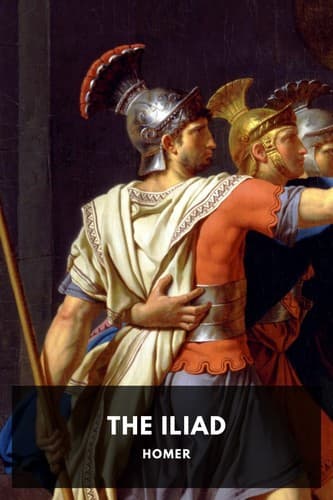
Achilles (Mythological character) -- Poetry; Classical literature; Epic poetry, Greek -- Translations into English; Trojan War -- Poetry
Till on my knee thou satt’st, and by my hand
Thy food were cut, the cup were tender’d thee;
And often, in thy childish helplessness.
The bosom of my dress with wine was drench’d;
Such care I had of thee, such pains I took,
Rememb’ring that by Heav’n’s decree, no son
Of mine I e’er might see; then thee I made,
Achilles, rival of the Gods, my son,
That thou mightst be the guardian of mine age.
But thou, Achilles, curb thy noble rage;
A heart implacable beseems thee not.
The Gods themselves, in virtue, honour, strength,
Excelling thee, may yet be mollified;
For they, when mortals have transgress’d, or fail’d
To do aright, by sacrifice and pray’r,
Libations and burnt-off’rings, may be sooth’d.
Pray’rs are the daughters of immortal Jove;
But halt, and wrinkled, and of feeble sight,
They plod in Ate’s track; while Ate, strong
And swift of foot, outstrips their laggard pace,
And, dealing woe to man, o’er all the earth
Before them flies: they, following, heal her wounds.
Him who with honour welcomes their approach,
They greatly aid, and hear him when he prays;
But who rejects, and sternly casts them off,
To Saturn’s son they go, and make their pray’r
That Ate follow him and claim her dues.
Then to the daughters of immortal Jove,
Do thou, Achilles, show the like respect,
That many another brave man’s heart hath sway’d.
If to thy tent no gifts Atrides brought,
With promises of more, but still retain’d
His vehement enmity, I could not ask
That thou thy cherish’d anger shouldst discard,
And aid the Greeks, how great so-e’er their need.
But now large off’rings hath he giv’n, and more
Hath promis’d; and, of all the Greeks, hath sent
To pray thine aid, the men thou lov’st the best.
Discredit not their mission, nor their words.
Till now, I grant thee, none could blame thy wrath.
In praise of men in ancient days renown’d,
This have we heard, that how-so-e’er might rage
Their hostile feuds, their anger might be still
By gifts averted, and by words appeas’d.
One case I bear in mind, in times long past,
And not in later days; and here, ’mid friends,
How all occurr’d, will I at length recite.
Time was, that with Ætolia’s warlike bands
Round Calydon the Acarnanians fought
With mutual slaughter; these to save the town,
The Acarnanians burning to destroy.
This curse of war the golden-throned Queen
Diana sent, in anger that from her
Œneus the first-fruits of his field withheld.
The other Gods their hecatombs receiv’d;
Diana’s shrine alone no off’rings deck’d,
Neglected, or o’erlook’d; the sin was great;
And in her wrath the arrow-darting Queen
A savage wild-boar sent, with gleaming tusks,
Which Œneus’ vineyard haunting, wrought him harm.
There laid he prostrate many a stately tree,
With root and branch, with blossom and with fruit.
Him Meleager, son of Œneus, slew,
With youths and dogs from all the neighbouring towns
Collected; smaller force had not avail’d,
So huge he was, so fierce; and many a youth
Had by his tusks been laid upon the bier.
Public-domain text, read in full here on John Shaqi.
Reviews
Reviews
No reviews yet
Be the first to share your thoughts on this work.
Elsewhere in the archive
Join the Discussion
Join the discussion
Sign in to leave a comment or review.
Sign InorCreate an account