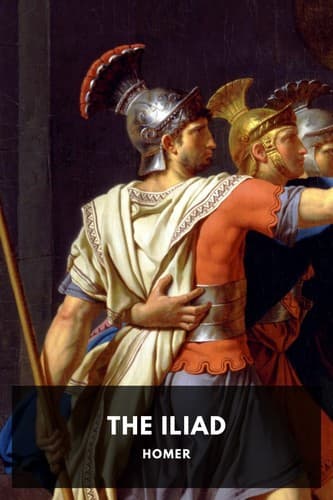
Achilles (Mythological character) -- Poetry; Classical literature; Epic poetry, Greek -- Translations into English; Trojan War -- Poetry
Upon the refusal of Achilles to return to the army, the distress of
Agamemnon is described in the most lively manner. He takes no rest that
night, but passes through the camp, awaking the leaders, and contriving
all possible methods for the public safety. Menelaus, Nestor, Ulysses,
and Diomed, are employed in raising the rest of the captains. They call
a council of war, and determine to send scouts into the enemy’s camp,
to learn their posture, and discover their intentions. Diomed
undertakes the hazardous enterprise, and makes choice of Ulysses for
his companion. In their passage they surprise Dolon, whom Hector had
sent on a like design to the camp of the Grecians. From him they are
informed of the situation of the Trojans and auxiliary forces, and
particularly of Rhesus, and the Thracians, who were lately arrived.
They pass on with success; kill Rhesus with several of his officers,
and seize the famous horses of that prince, with which they return in
triumph to the camp.
The same night continues; the scene lies in the two camps.
BOOK X.
In night-long slumbers lay the other chiefs
Of all the Greeks, by gentle sleep subdued;
But not on Agamemnon, Atreus’ son,
By various cares oppress’d, sweet slumber fell.
As when from Jove, the fair-hair’d Juno’s Lord,
Flashes the lightning, bringing in its train
Tempestuous storm of mingled rain and hail
Or snow, by winter sprinkled o’er the fields;
Or op’ning wide the rav’nous jaws of war;
So Agamemnon from his inmost heart
Pour’d forth in groans his multitudinous grief,
His spirit within him sinking. On the plain
He look’d, and there, alarm’d, the watchfires saw,
Which, far advanc’d before the walls of Troy,
Blaz’d numberless; and thence of pipes and flutes
He heard the sound, and busy hum of men.
Upon the ships he look’d, and men of Greece,
And by the roots his hair in handfuls tore
To Jove on high; deep groan’d his mighty heart.
Thus as he mus’d, the wisest course appear’d,
With Nestor, son of Neleus, to confer,
If they some scheme in council might devise
To ward destruction from the Grecian host.
He rose, and o’er his body drew his vest,
And underneath his well-turn’d feet he bound
His sandals fair; then o’er his shoulders threw,
Down reaching to his feet, a lion’s skin,
Tawny and vast; then grasp’d his pond’rous spear.
On Menelaus weigh’d an equal dread;
Nor on his eyes that night had slumber sat,
Lest ill befall the Greeks; who, in his cause,
Crossing the wat’ry waste, had come to Troy,
And bold defiance to the Trojans giv’n.
Round his broad chest a panther’s skin he threw;
Then on his head his brazen helmet plac’d,
And in his brawny hand a lance he bore.
To meet his brother went he forth, of Greece
The mighty monarch, as a God rever’d.
Him by the ship he found, in act to arm;
And welcome was his presence to the King.
Public-domain text, read in full here on John Shaqi.
Reviews
Reviews
No reviews yet
Be the first to share your thoughts on this work.
Elsewhere in the archive
Join the Discussion
Join the discussion
Sign in to leave a comment or review.
Sign InorCreate an account