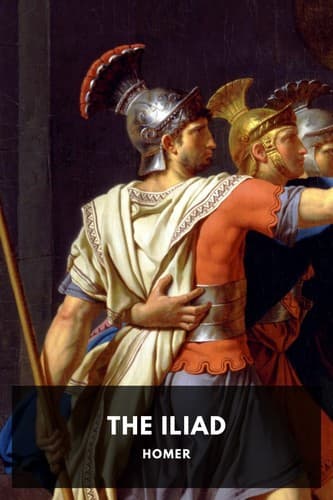
Achilles (Mythological character) -- Poetry; Classical literature; Epic poetry, Greek -- Translations into English; Trojan War -- Poetry
“Trojans and Lycians, and ye Dardans fam’d
In close encounter, quit ye now like men;
Against the ships your wonted valour show.
E’en now, before our eyes, hath Jove destroy’d
A chieftain’s weapon. Easy ’tis to trace
O’er human wars th’ o’erruling hand of Jove,
To whom he gives the prize of victory,
And whom, withholding aid, he minishes,
As now the Greeks, while we his favour gain.
Pour then your force united on the ships;
And if there be among you, who this day
Shall meet his doom, by sword or arrow slain,
E’en let him die! a glorious death is his
Who for his country falls; and dying, leaves
Preserv’d from danger, children, wife, and home,
His heritage uninjur’d, when the Greeks
Embarking hence shall take their homeward way.”
His words fresh courage rous’d in ev’ry breast.
Ajax, on th’ other side, address’d the Greeks:
“Shame on ye, Greeks! this very hour decides
If we must perish, or be sav’d, and ward
Destruction from our ships; and can ye hope
That each, if Hector of the glancing helm
Shall burn our ships, on foot can reach his home?
Or hear ye not, how, burning to destroy
Our vessels, Hector cheers his forces on?
Not to the dance, but to the fight he calls;
Nor better counsel can for us be found,
Than in close fight with heart and hand to join.
’Twere better far at once to die, than live
Hemm’d in and straiten’d thus, in dire distress,
Close to our ships, by meaner men beset.”
His words fresh courage rous’d in ev’ry breast.
Then Hector Schedius, Perimedes’ son,
The Thracian leader, slew; on th’ other side
Ajax the captain of the foot o’ercame,
Laodamas, Antenor’s noble son;
While of his arms Polydamas despoil’d
Cyllenian Otus, friend of Phyleus’ son,
The proud Epeians’ leader; Meges saw,
And rush’d upon him; but Polydamas,
Stooping, the blow evaded; him he miss’d;
For Phoebus will’d not Panthous’ son should fall
In the front rank contending; but the spear
Smote Croesmus through the breast; thund’ring he fell,
And from his corpse the victor stripp’d his arms.
Him Dolops, son of Lampus, spearman skill’d,
Well train’d in ev’ry point of war, assail’d
(The son of Lampus he, the prince of men,
Son of Laomedon); from close at hand
Forward he sprang, and thrust at Meges’ shield;
But him the solid corslet which he wore,
With breast and back-piece fitted, sav’d from harm:*
The corslet Phyleus brought from Ephyra,
By Selles’ stream; Euphetes, King of men,
Bestow’d it as a friendly gift, to wear
In battle for a guard from hostile spears;
Which from destruction now preserv’d his son.
Next Meges struck, with keen-edg’d spear, the crown
Of Dolops’ brass-bound, horsehair-crested helm,
Sev’ring the horsehair plume, which, brilliant late
With crimson dye, now lay defil’d in dust.
Yet fought he on, and still for vict’ry hop’d;
But warlike Menelaus to the aid
Of Meges came; of Dolops unobserv’d
He stood, and from behind his shoulder pierc’d;
The point, its course pursuing, through his breast
Was driv’n, and headlong on his face he fell.
Public-domain text, read in full here on John Shaqi.
Reviews
Reviews
No reviews yet
Be the first to share your thoughts on this work.
Elsewhere in the archive
Join the Discussion
Join the discussion
Sign in to leave a comment or review.
Sign InorCreate an account