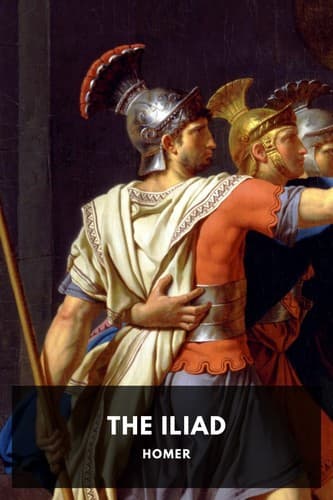
Achilles (Mythological character) -- Poetry; Classical literature; Epic poetry, Greek -- Translations into English; Trojan War -- Poetry
As when, encount’ring in some mountain-glen,
Eurus and Notus shake the forest deep,
Of oak, or ash, or slender cornel-tree,
Whose tap’ring branches are together thrown,
With fearful din, and crash of broken boughs;
So mix’d confus’dly, Greeks and Trojans fought,
No thought of flight by either entertain’d.
Thick o’er Cebriones the jav’lins flew,
And feather’d arrows, bounding from the string;
And pond’rous stones that on the bucklers rang,
As round the dead they fought; amid the dust
That eddying rose, his art forgotten all,
A mighty warrior, mightily he lay.
While in mid Heav’n the sun pursued his course,
Thick flew the shafts, and fast the people fell
On either side; but when declining day
Brought on the hour that sees the loosen’d steers,
The Greeks were stronger far; and from the darts
And Trojan battle-cry Cebriones
They drew, and from his breast his armour stripp’d.
Fiercely Patroclus on the Trojans fell:
Thrice he assail’d them, terrible as Mars,
With fearful shouts; and thrice nine foes he slew:
But when again, with more than mortal force
His fourth assault he made, thy term of life,
Patroclus, then approach’d its final close;
For Phoebus’ awful self encounter’d thee,
Amid the battle-throng, of thee unseen,
For thickest darkness shrouded all his form:
He stood behind, and with extended palm
Dealt on Patroclus’ neck and shoulders broad
A mighty buffet; dizzy swam his eyes,
And from his head Apollo snatch’d the helm;
Clank’d, as it roll’d beneath the horses’ feet,
The visor’d helm; the horsehair plume with blood
And dust polluted; never till that day
Was that proud helmet so with dust defil’d,
That wont to deck a godlike chief, and guard
Achilles’ noble head, and graceful brow:
Now by the will of Jove to Hector giv’n.
Now death was near at hand; and in his grasp
His spear was shiver’d, pond’rous, long, and tough,
Brass-pointed; with its belt, the ample shield
Fell from his shoulders; and Apollo’s hand,
The royal son of Jove, his corslet loos’d.
Then was his mind bewilder’d; and his limbs
Gave way beneath him; all aghast he stood:
Him, from behind, a Dardan, Panthous’ son,
Euphorbus, peerless ’mid the Trojan youth,
To hurl the spear, to run, to drive the car,
Approaching close, between the shoulders stabb’d;
He, train’d to warfare, from his car, ere this
A score of Greeks had from their chariots hurl’d:
Such was the man who thee, Patroclus, first
Wounded, but not subdued; the ashen spear
He, in all haste, withdrew; nor dar’d confront
Patroclus, though disarm’d, in deadly strife.
Back to his comrades’ shelt’ring ranks retir’d,
From certain death, Patroclus: by the stroke
Of Phoebus vanquish’d, and Euphorbus’ spear:
But Hector, when Patroclus from the fight
He saw retreating, wounded, through the ranks
Advancing, smote him through the flank; right through
The brazen spear was driv’n; thund’ring he fell;
And deeply mourn’d his fall the Grecian host.
Public-domain text, read in full here on John Shaqi.
Reviews
Reviews
No reviews yet
Be the first to share your thoughts on this work.
Elsewhere in the archive
Join the Discussion
Join the discussion
Sign in to leave a comment or review.
Sign InorCreate an account