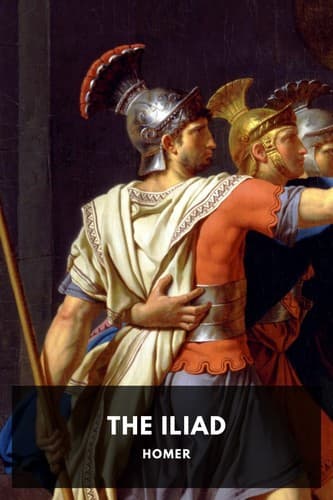
Achilles (Mythological character) -- Poetry; Classical literature; Epic poetry, Greek -- Translations into English; Trojan War -- Poetry
He said, nor did Atrides not comply;
But slow as moves a lion from the fold,
Which dogs and youths with ceaseless toil hath worn,
Who all night long have kept their watch, to guard
From his assault the choicest of the herd;
He, hunger-pinch’d, hath oft th’ attempt renew’d,
But nought prevail’d; by spears on ev’ry side,
And jav’lins met, wielded by stalwart hands,
And blazing torches, which his courage daunt;
Till with the morn he sullenly withdraws;
So from Patroclus, with reluctant step
Atrides mov’d; for much he fear’d the Greeks
Might to the Trojans, panic-struck, the dead
Abandon; and departing, he besought
The two Ajaces and Meriones:
“Ye two Ajaces, leaders of the Greeks,
And thou, Meriones, remember now
Our lost Patroclus’ gentle courtesy,
How kind and genial was his soul to all,
While yet he liv’d—now sunk, alas! in death.”
Thus saying, Menelaus took his way,
Casting his glance around on ev’ry side,
Like to an eagle, fam’d of sharpest sight
Of all that fly beneath the vault of Heav’n;
Whom, soaring in the clouds, the crouching hare
Eludes not, though in leafiest covert hid;
But swooping down, he rends her life away:
So, Menelaus, through the ranks of war
Thy piercing glances ev’ry way were turn’d,
If Nestor’s son, alive, thou mightst descry;
Him on the field’s extremest left he found,
Cheering his friends, and urging to the fight;
He stood beside him, and address’d him thus:
“Antilochus, come hither, godlike friend,
And woful tidings hear, which would to Heav’n
I had not to impart; thyself thou seest
How Jove hath heap’d disaster on the Greeks,
And vict’ry giv’n to Troy; but one has fallen,
Our bravest, best! Patroclus lies in death;
And deeply must the Greeks his loss deplore.
But haste thee to the ships, to Peleus’ son
The tidings bear, if haply he may save
The body of Patroclus from the foe;
His naked body, for his arms are now
The prize of Hector of the glancing helm.”
He said; and at his words Antilochus
Astounded stood; long time his tongue in vain
For utt’rance strove; his eyes were fill’d with tears,
His cheerful voice was mute; yet not the less
To Menelaus’ bidding gave his care:
Swiftly he sped; but to Laodocus,
His comrade brave, who waited with his car
In close attendance, first consign’d his arms;
Then from the field with active limbs he flew,
Weeping, with mournful news, to Peleus’ son.
Nor, noble Menelaus, did thy heart
Incline thee to remain, and aid thy friends,
Where from their war-worn ranks the Pylian troops
Deplor’d the absence of Antilochus;
But these in godlike Thrasymedes’ charge
He left; and to Patroclus hast’ning back,
Beside th’ Ajaces stood, as thus he spoke:
“Him to Achilles, to the ships, in haste
I have despatch’d; yet fiercely as his wrath
May burn tow’rd Hector, I can scarce expect
His presence here; for how could he, unarm’d,
With Trojans fight? But take we counsel now
How from the field to bear away our dead,
And ’scape ourselves from death by Trojan hands.”
Public-domain text, read in full here on John Shaqi.
Reviews
Reviews
No reviews yet
Be the first to share your thoughts on this work.
Elsewhere in the archive
Join the Discussion
Join the discussion
Sign in to leave a comment or review.
Sign InorCreate an account