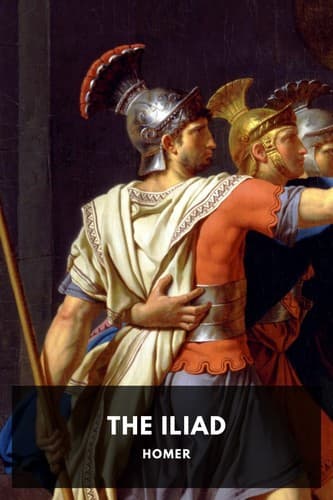
Achilles (Mythological character) -- Poetry; Classical literature; Epic poetry, Greek -- Translations into English; Trojan War -- Poetry
He said: the well-greav’d Greeks rejoic’d to hear
His wrath abjur’d by Peleus’ godlike son;
And from his seat, not standing in the midst,
Thus to th’ assembly Agamemnon spoke:
“Friends, Grecian Heroes, Ministers of Mars,
When one stands up to speak, ’tis meet for all
To lend a patient ear, nor interrupt;
For e’en to practis’d speakers hard the task:
But, in this vast assembly, who can speak
That all may hear? the clearest voice must fail.
To Peleus’ son, Achilles, I my mind
Will frankly open; ye among yourselves
Impart the words I speak, that all may know.
Oft hath this matter been by Greeks discuss’d,
And I their frequent censure have incurr’d:
Yet was not I the cause; but Jove, and Fate,
And gloomy Erinnys, who combin’d to throw
A strong delusion o’er my mind, that day
I robb’d Achilles of his lawful prize.
What could I do? a Goddess all o’er-rul’d,
Daughter of Jove, dread Ate, baleful pow’r,
Misleading all; with lightest step she moves,
Not on the earth, but o’er the heads of men,
With blighting touch; and many hath caus’d to err.
E’en Jove, the wisest deem’d of Gods and men,
In error she involv’d, when Juno’s art
By female stratagem the God deceiv’d,
When in well-girdled Thebes Alcmena lay
In travail of the might of Hercules.
In boastful tone amid the Gods he spoke:
‘Hear all ye Gods, and all ye Goddesses,
The words I speak, the promptings of my soul.
This day Lucina shall to light bring forth
A child, the future Lord of all around,
Of mortal men, who trace to me their blood.’
Whom answer’d Juno thus, with deep deceit:
‘Thou dost but feign, nor wilt fulfil thy word:
Come now, Olympian, swear a solemn oath
That he shall be the Lord of all around,
Who on this day shall be of woman born,
Of mortal men, who trace to thee their blood.’
She said, and Jove, the snare unseeing, swore
A solemn oath; but found his error soon.
Down from Olympus’ height she sped in haste
To Argos of Achaia; for the wife
Of Sthenelus, the son of Perseus, there,
She knew, was sev’n months pregnant of a son;
Whom, though untimely born, she brought to light,
Staying meanwhile Alcmena’s labour-pangs,
To Saturn’s son herself the tidings brought,
And thus address’d him: ‘Jove, the lightning’s Lord,
I bring thee news; this day a mighty man,
By thee ordain’d to be the Argives’ King,
Is born, Eurystheus, son of Sthenelus,
The son of Perseus, issue of thy blood;
Well worthy he to be the Argives’ King.’
She said: keen sorrow deeply pierc’d his soul;
Then Ate by the glossy locks he seiz’d
In mighty wrath; and swore a solemn oath,
That to Olympus and the starry Heav’n
She never should return, who all misleads.
His arm then whirling, from the starry Heav’n
He flung her down, to vex th’ affairs of men.
Yet oft her fraud remember’d he with groans,
When by Eurystheus’ hard commands he saw
Condemn’d to servile tasks his noble son.
So, oft as Hector of the glancing helm
Beside the ships the Greeks to slaughter gave,
Back to my mind my former error came.
Public-domain text, read in full here on John Shaqi.
Reviews
Reviews
No reviews yet
Be the first to share your thoughts on this work.
Elsewhere in the archive
Join the Discussion
Join the discussion
Sign in to leave a comment or review.
Sign InorCreate an account