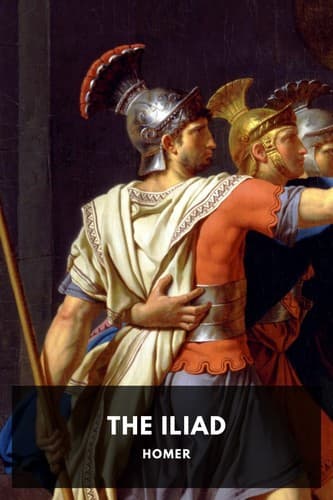
Achilles (Mythological character) -- Poetry; Classical literature; Epic poetry, Greek -- Translations into English; Trojan War -- Poetry
“Æneas, why so far before the ranks
Advanc’d? dost thou presume with me to fight?
Perchance expecting that the throne of Troy
And Priam’s royal honours may be thine.
E’en if thou slay me, deem not to obtain
Such boon from Priam; valiant sons are his,
And he not weak, but bears a constant mind.
Or have the Trojans set apart for thee
Some favour’d spot, the fairest of the land,
Orchard or corn-land, shouldst thou work my death;
Which thou shalt find, I trust, too hard a task?
Already hast thou fled before my spear;
Hast thou forgotten how amid thy herds
Alone I found thee, and with flying foot
Pursued thee down the steep of Ida’s hill?
Nor didst thou dare to turn, or pause in flight.
Thou to Lyrnessus fledd’st; Lyrnessus I,
With Pallas’ aid and Jove’s, assail’d and took:
Their women thence, their days of freedom lost,
I bore away, my captives; thee from death,
Jove and the other Gods defended then;
But will not now bestow, though such thy hope,
Their succour; then I warn thee, while ’tis time,
Ere ill betide thee, to the gen’ral throng
That thou withdraw, nor stand to me oppos’d:
After th’ event may e’en a fool be wise.”
To whom in answer thus Æneas spoke:
“Achilles, think not me, as though a fool,
To daunt with lofty speech; I too could well
With cutting words, and insult, answer thee.
Each other’s race and parents well we know
From tales of ancient days; although by sight
Nor mine to thee, nor thine to me are known.
To noble Peleus thou, ’tis said, wast born
Of Thetis, fair-hair’d daughter of the sea;
Of great Anchises, Heav’n-descended chief,
I boast me sprung, to him by Venus borne.
Of these shall one or other have this day
To mourn their son; since not with empty words
Shall thou and I from mortal combat part.
But if thou farther wouldst enquire, and learn
The race I spring from, not unknown to men,
By Dardanus, of cloud-compelling Jove
Begotten, was Dardania peopled first,
Ere sacred Ilium, populous city of men,
Was founded on the plain; as yet they dwelt
On spring-abounding Ida’s lowest spurs.
To Dardanus was Erichthonius born,
Great King, the wealthiest of the sons of men;
For him were pastur’d in the marshy mead,
Rejoicing with their foals, three thousand mares;
Them Boreas, in the pasture where they fed,
Beheld, enamour’d; and amid the herd
In likeness of a coal-black steed appear’d;
Twelve foals, by him conceiving, they produc’d.
These, o’er the teeming corn-fields as they flew,
Skimm’d o’er the standing ears, nor broke the haulm;
And, o’er wide Ocean’s bosom as they flew,
Skimm’d o’er the topmost spray of th’ hoary sea
Again, to Erichthonius Tros was born,
The King of Troy; three noble sons were his,
Ilus, Assaracus, and Ganymede;
The fairest he of all the sons of men;
Him, for his beauty, bore the Gods away,
To minister as cup-bearer to Jove,
And dwell amid th’ Immortals: Ilus next
Begot a noble son, Laomedon;
Tithonus he, and Priam; Clytius,
Lampus and Icetaon, plant of Mars;
Capys, begotten of Assaracus,
Public-domain text, read in full here on John Shaqi.
Reviews
Reviews
No reviews yet
Be the first to share your thoughts on this work.
Elsewhere in the archive
Join the Discussion
Join the discussion
Sign in to leave a comment or review.
Sign InorCreate an account