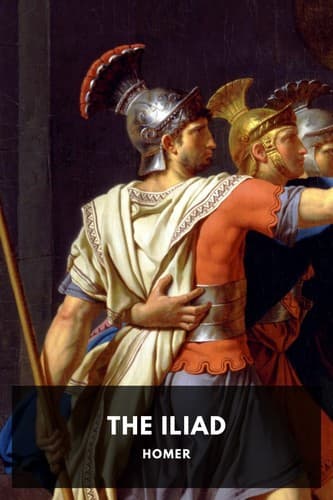
Achilles (Mythological character) -- Poetry; Classical literature; Epic poetry, Greek -- Translations into English; Trojan War -- Poetry
Weeping, she spoke; but nought as yet was known
To Hector’s wife; to her no messenger
Had brought the tidings, that without the walls
Remained her husband; in her house withdrawn
A web she wove, all purple, double woof,
With varied flow’rs in rich embroidery,
And to her neat-hair’d maidens gave command
To place the largest caldrons on the fire,
That with warm baths, returning from the fight,
Hector might be refresh’d; unconscious she,
That by Achilles’ hand, with Pallas’ aid,
Far from the bath, was godlike Hector slain.
The sounds of wailing reach’d her from the tow’r;
Totter’d her limbs, the distaff left her hand,
And to her neat-hair’d maidens thus she spoke:
“Haste, follow me, some two, that I may know
What mean these sounds; my honour’d mother’s voice
I hear; and in my breast my beating heart
Leaps to my mouth; my limbs refuse to move;
Some evil, sure, on Priam’s house impends.
Be unfulfill’d my words! yet much I fear
Lest my brave Hector be cut off alone,
By great Achilles, from the walls of Troy,
Chas’d to the plain, the desp’rate courage quench’d,
Which ever led him from the gen’ral ranks
Far in advance, and bade him yield to none.”
Then from the house she rush’d, like one distract,
With beating heart; and with her went her maids.
But when she reach’d the tow’r, where stood the crowd,
And mounted on the wall, she look’d around,
And saw the body which with insult foul
The flying steeds were dragging towards the ships;
Then sudden darkness overspread her eyes;
Backward she fell, and gasp’d her spirit away.
Far off were flung th’ adornments of her head,
The net, the fillet, and the woven bands;
The nuptial veil by golden Venus giv’n,
That day when Hector of the glancing helm
Led from Eetion’s house his wealthy bride.
The sisters of her husband round her press’d,
And held, as in the deadly swoon she lay.
But when her breath and spirit return’d again,
With sudden burst of anguish thus she cried:
“Hector, oh woe is me! to misery
We both were born alike; thou here in Troy
In Priam’s royal palace; I in Thebes,
By wooded Placos, in Eetion’s house,
Who nurs’d my infancy; unhappy he,
Unhappier I! would I had ne’er been born!
Now thou beneath the depths of earth art gone,
Gone to the viewless shades; and me hast left
A widow in thy house, in deepest woe;
Our child, an infant still, thy child and mine,
Ill-fated parents both! nor thou to him,
Hector, shalt be a guard, nor he to thee:
For though he ’scape this tearful war with Greece,
Yet nought for him remains but ceaseless woe,
And strangers on his heritage shall seize.
No young companions own the orphan boy:
With downcast eyes, and cheeks bedew’d with tears,
His father’s friends approaching, pinch’d with want,
He hangs upon the skirt of one, of one
He plucks the cloak; perchance in pity some
May at their tables let him sip the cup,
Moisten his lips, but scarce his palate touch;
While youths, with both surviving parents bless’d,
May drive him from their feast with blows and taunts,
Public-domain text, read in full here on John Shaqi.
Reviews
Reviews
No reviews yet
Be the first to share your thoughts on this work.
Elsewhere in the archive
Join the Discussion
Join the discussion
Sign in to leave a comment or review.
Sign InorCreate an account