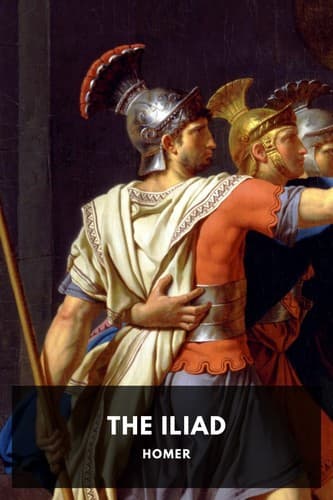
Achilles (Mythological character) -- Poetry; Classical literature; Epic poetry, Greek -- Translations into English; Trojan War -- Poetry
“Antilochus, till now reputed wise,
What hast thou done? thou hast impugn’d my skill,
And sham’d my horses, who hast brought thine own,
Inferior far, before them to the goal.
But come, ye chiefs and councillors of Greece,
Judge ye between us, fav’ring neither side:
That none of all the brass-clad Greeks may say
That Menelaus hath by false reports
O’erborne Antilochus, and holds his prize:
His horses fairly worsted, and himself
Triumphant only by superior pow’r.
Or come now, I myself will judgment give;
Nor deem I any Greek will find to blame
In my decision, for ’tis fair and just.
Antilochus, come forward, noble chief;
And standing, as ’tis meet, before the car
And horses, in thy hand the slender whip
Wherewith thou drov’st, upon the horses lay
Thy hand, and by Earth-shaking Neptune swear
That not of malice, and by set design,
Thou didst by fraud impede my chariot’s course.”
To whom Antilochus with prudent speech:
“Have patience with me yet; for I, O King,
O Menelaus, am thy junior far;
My elder and superior thee I own.
Thou know’st th’ o’er-eager vehemence of youth,
How quick in temper, and in judgment weak.
Set then thy heart at ease; the mare I won
I freely give; and if aught else of mine
Thou shouldst desire, would sooner give it all,
Than all my life be low’r’d, illustrious King,
In thine esteem, and sin against the Gods.”
Thus saying, noble Nestor’s son led forth,
And plac’d in Menelaus’ hands the mare:
The monarch’s soul was melted, like the dew
Which glitters on the ears of growing corn,
That bristle o’er the plain; e’en so thy soul,
O Menelaus, melted at his speech;
To whom were thus address’d thy winged words:
“Antilochus, at once I lay aside
My anger; thou art prudent, and not apt
To be thus led astray; but now thy youth
Thy judgment hath o’erpow’r’d; seek not henceforth
By trick’ry o’er thine elders to prevail.
To any other man of all the Greeks
I scarce so much had yielded; but for that
Thyself hast labour’d much, and much endur’d,
Thou, thy good sire, and brother, in my cause:
I yield me to thy pray’rs; and give, to boot,
The mare, though mine of right; that these may know
I am not of a harsh, unyielding mood.”
He said, and to Noemon gave in charge,
The faithful comrade of Antilochus,
The mare; himself the glitt’ring caldron took.
Of gold two talents, to the fourth assign’d,
Fourth in the race, Meriones receiv’d;
Still the fifth prize, a vase with double cup,
Remain’d; Achilles this to Nestor gave,
Before th’ assembled Greeks, as thus he spoke:
“Take this, old man, and for an heirloom keep,
In mem’ry of Patroclus’ fun’ral games,
Whom thou no more amid the Greeks shalt see.
Freely I give it thee; for thou no more
Canst box, or wrestle, or in sportive strife
The jav’lin throw, or race with flying feet;
For age with heavy hand hath bow’d thee down.”
He said, and plac’d it in his hand; th’ old man
Beceiv’d with joy the gift, and thus replied:
Public-domain text, read in full here on John Shaqi.
Reviews
Reviews
No reviews yet
Be the first to share your thoughts on this work.
Elsewhere in the archive
Join the Discussion
Join the discussion
Sign in to leave a comment or review.
Sign InorCreate an account