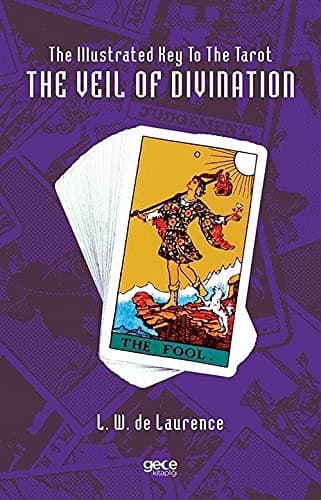
The Illustrated Key to the Tarot: The Veil of DivinationDe Laurence, L. W. (Lauron William)
Religion
The Illustrated Key to the Tarot: The Veil of Divination
De Laurence, L. W. (Lauron William)
Fortune-telling by cards; Tarot
4 Fives = order; 3 Fives = hesitation; 2 Fives = reverse.
4 Fours = walks abroad; 3 Fours = disquiet; 2 Fours = dispute.
4 Threes = great success; 3 Threes = serenity; 2 Threes = safety.
4 Twos = reconciliation; 3 Twos = apprehension; 2 Twos = mistrust.
4 Aces = dishonor; 3 Aces = debauchery; 2 Aces = enemies.
Section 6
THE ART OF TAROT DIVINATION
We come now to the final and practical part of this division of
our subject, being the way to consult and obtain oracles by means
of Tarot cards. The modes of operation are rather numerous,
and some of them are exceedingly involved. I set aside those
last mentioned, because persons who are versed in such questions
believe that the way of simplicity is the way of truth. I set aside
also the operations which have been republished recently in that
section of The Tarot Of The Bohemians which is entitled "The
Divining Tarot"; it may be recommended at its proper value to
readers who wish to go further than the limits of this handbook.
I offer in the first place a short process which has been used privately
for many years past in England, Scotland and Ireland. I
do not think that it has been published—certainly not in connection
with Tarot cards; I believe that it will serve all purposes, but
I will add—by way of variation—in the second place what used to
be known in France as the Oracles of Julia Orsini.
Section 7
AN ANCIENT CELTIC METHOD OF DIVINATION
This mode of divination is the most suitable for obtaining an
answer to a definite question. The Diviner first selects a card to
represent the person or matter about which inquiry is made.
This card is called the Significator. Should he wish to ascertain
something in connection with himself he takes the one which
corresponds to his personal description. A Knight should be
chosen as the Significator if the subject of inquiry is a man of
forty years old and upward; A King should be chosen for any
male who is under that age; a Queen for a woman over forty
years; and a Page for any female of less age.
The four Court Cards in Wands represent very fair people,
with yellow or auburn hair, fair complexion and blue eyes. The
Court Cards in Cups signify people with light brown or dull fair
hair and grey or blue eyes. Those in Swords stand for people
having hazel or grey eyes, dark brown hair and dull complexion.
Lastly, the Court Cards in Pentacles are referred to persons with
very dark brown or black hair, dark eyes and sallow or swarthy
complexions. These allocations are subject, however, to the
following reserve, which will prevent them being taken too conventionally.
You can be guided on occasion by the known
temperament of a person; one who is exceedingly dark may be
very energetic, and would be better represented by a Sword card
than a Pentacle. On the other hand, a very fair subject who is
indolent and lethargic should be referred to Cups rather than to
Wands.
Public-domain text, read in full here on John Shaqi.
Reviews
Reviews
No reviews yet
Be the first to share your thoughts on this work.
Elsewhere in the archive
Join the Discussion
Join the discussion
Sign in to leave a comment or review.
Sign InorCreate an account