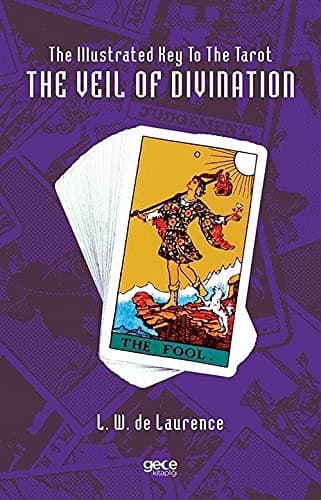
The Illustrated Key to the Tarot: The Veil of DivinationDe Laurence, L. W. (Lauron William)
Religion
The Illustrated Key to the Tarot: The Veil of Divination
De Laurence, L. W. (Lauron William)
Fortune-telling by cards; Tarot
The value of intuitive and clairvoyant faculties is of course
assumed in divination. Where these are naturally present or
have been developed by the Diviner, the fortuitous arrangement
of cards forms a link between his mind and the atmosphere of
the subject of divination, and then the rest is simple. Where
intuition fails, or is absent, concentration, intellectual observation
and deduction must be used to the fullest extent to obtain a satisfactory
result. But intuition, even if apparently dormant, may
be cultivated by practice in these divinatory processes. If in
doubt as to the exact meaning of a card in a particular connection,
the Diviner is recommended, by those who are versed in the
matter, to place his hand on it, try to refrain from thinking of
what it ought to be, and note the impressions that arise in his
mind. At the beginning this will probably resolve itself into
mere guessing and may prove incorrect, but it becomes possible
with practice to distinguish between a guess of the conscious mind
and an impression arising from the mind which is sub-conscious.
It is not within my province to offer either theoretical or practical
suggestions on this subject, in which I have no part, but the
following additamenta have been contributed by one who has
more titles to speak than all the cartomancists of Europe, if they
could shuffle with a single pair of hands and divine with one
tongue.
Notes On The Practice Of Divination
1. Before beginning the operation, formulate your question
definitely, and repeat it aloud.
2. Make your mind as blank as possible while shuffling the
cards.
3. Put out of the mind personal bias and preconceived ideas as
far as possible, or your judgment will be tinctured thereby.
4. On this account it is more easy to divine correctly for a
stranger than for yourself or a friend.
Section 9
THE METHOD OF READING BY MEANS OF THIRTY-FIVE CARDS
When the reading is over, according to the scheme set forth in
the last method, it may happen—as in the previous case—that
something remains doubtful, or it may be desired to carry the
question further, which is done as follows:
Take up the undealt cards which remain over, not having been
used in the first operation with 42 cards. The latter are set aside
in a heap, with the Querent, face upwards, on the top. The
thirty-five cards, being shuffled and cut as before, are divided by
dealing into six packets thus:—
Packet I consists of the first Seven Cards; Packet II consists
of the Six Cards next following in order; Packet III consists of
the Five Cards following; Packet IV contains the next Four
Cards; Packet V contains Two Cards; and Packet VI contains
the last Eleven Cards. The arrangement will then be as
follows:—
Take up these packets successively; deal out the cards which
they contain in six lines, which will be necessarily of unequal
length.
The First Line stands for the house, the environment and so
forth.
Public-domain text, read in full here on John Shaqi.
Reviews
Reviews
No reviews yet
Be the first to share your thoughts on this work.
Elsewhere in the archive
Join the Discussion
Join the discussion
Sign in to leave a comment or review.
Sign InorCreate an account