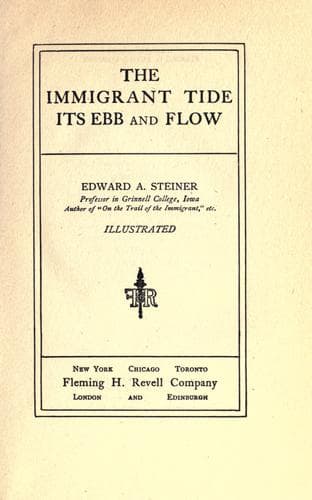
The Immigrant Tide, Its Ebb and FlowSteiner, Edward Alfred
History
The Immigrant Tide, Its Ebb and Flow
Steiner, Edward Alfred
United States -- Emigration and immigration
In these days most people believe that when the last Irishman has
arrived from Dublin, the Old World will be drained of her best people,
and we look upon a certain boundary line in Europe as the division
between good people and bad; yet from beyond that line come pilgrim
bands in much larger numbers than the casual observer knows, and they
are bent upon the same holy errand as that which brought those who came
generations ago. In fact the Reformation with its religious and
political consequences is making itself felt at this late day in these
migratory movements. Large groups driven to the plains of the Volga or
the Danube are now coming to the United States; with narrow doctrines,
it is true, but with deep convictions, and the churches of the
Reformation feel this current in the measure in which they have kept
themselves spiritually alert. Yet one must admit that the vast majority
of those who come is driven by no higher motive than the economic
pressure. Yet it is not always poverty which drives them from their
village homes to our cities or from their quiet fields to our noisy
shops.
They are no poorer to-day than they were fifty years ago when no one
thought of moving even a league from the village in which he was born.
They are simply obeying an impulse which is extending to the very edges
of civilization; an impulse created by discontent. Everywhere men are
beginning to believe that God meant them to enjoy the good things of
life _now_, and that all men, not merely a privileged class, should be
able to enjoy them.
Nothing ever quite so rudely shattered the idea of the stability of
wealth as the discovery of America and the subsequent migrations there
of different groups from different portions of Europe.
Wealth had been in a measure entailed, the possession of a class; and
poverty was meekly accepted as the divine apportionment to the mass of
men. When it was rumoured that gold lay hidden in the mountains across
the sea, that no key was needed to gain access to its hiding-place, and
that it would belong to any one who dared, the myth was quickly
dissolved. Poor men came and got their share of gold--not so often by
finding it as by toiling for it.
Further and further the truth travelled; slowly, as is the way of truth;
until to-day, scarcely anywhere is the prevailing social order or
economic status accepted as fixed. The greater the number of men
returning from America, even with very moderate wealth, the more the
discontent spreads, and men seek the place where this change may soonest
be effected.
Public-domain text, read in full here on John Shaqi.
Reviews
Reviews
No reviews yet
Be the first to share your thoughts on this work.
Elsewhere in the archive
Join the Discussion
Join the discussion
Sign in to leave a comment or review.
Sign InorCreate an account