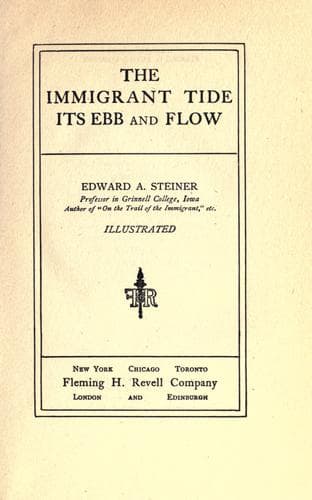
The Immigrant Tide, Its Ebb and FlowSteiner, Edward Alfred
History
The Immigrant Tide, Its Ebb and Flow
Steiner, Edward Alfred
United States -- Emigration and immigration
It must also teach him that besides its sacramental value it has service
value, whose obligations rest upon priest and people alike.
Religion must wean him from his ancient enemies, intemperance and
superstition, and when it has done this, it has rendered a service which
may again make of the Slavs a homogeneous race; great, vital, virile and
well prepared to play a leading part in the future history of Europe as
well as America, where they are now, numerically at least, the most
important element in the great immigrant tide.
XVI
FROM EPHRATA TO WHISKEY HILL
That portion of our history, which began with the inflow of Germans from
the Palatinate, seems to most of us a closed chapter; yet in the very
heart of the Keystone State, where more than 200 years ago the German
pietist began to build its cities, since grown to greatness, the German
is still a foreigner.
Indeed, he is almost as complete a foreigner as the Slav who lives in
the mining patches along the Wyoming arid Susquehanna Rivers. Germanic
speech, habits and types survive, and it was in a crowded trolley car in
Reading, Pa., just after I had finished a wearisome investigation among
the Slavs, that a woman of generously Teutonic proportions said to me:
"Setz dich a mahl zu mir her."
Let me add that although I had never seen the lady before, I obeyed the
summons. First, because there was no other seat vacant, and, second,
because I have been long enough in America to obey implicitly when a
lady commands.
"Du acts wie ein stranger," the good woman continued, taking my hand;
and then, discovering that I had a right to act like a stranger, she
apologized profusely. She had mistaken me for her family physician. In
spite of her evident embarrassment, we began a conversation, and my
ears, accustomed as they now are to our rather monotonous and uneuphonic
English, refreshed themselves by listening to this new speech--Pennsylvania
Dutch. It required thinking in two languages, and that in their most
archaic forms.
Four generations had passed since my neighbour's ancestors came to this
country; yet her English, whenever she attempted it, smacked strongly of
the Fatherland, and in an unguarded moment, when my sentences seemed to
her rather involved, she said, "Du talkst a bissel zu fast."
Public-domain text, read in full here on John Shaqi.
Reviews
Reviews
No reviews yet
Be the first to share your thoughts on this work.
Elsewhere in the archive
Join the Discussion
Join the discussion
Sign in to leave a comment or review.
Sign InorCreate an account