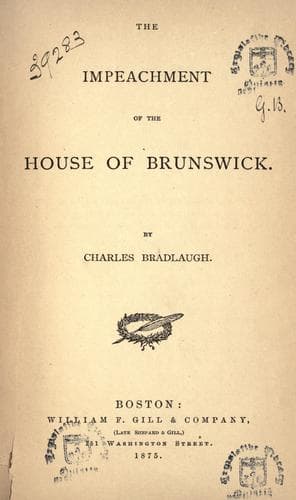
The Impeachment of the House of BrunswickBradlaugh, Charles
History
The Impeachment of the House of Brunswick
Bradlaugh, Charles
Great Britain -- History -- 1714-1837; Hanover, House of
The _Edinburgh Review_, soon after the King's death, while admitting
that "his understanding may not have been of as high an order as his
good nature," says: "We have learned to forget the faults of the Duke
of Clarence in the merits of William IV." Where were these merits
shown? Was it in "brooding"--(to use the expression of his own private
secretary)--over questions of whether he could, during the commencement
of his reign, personally appropriate sums of money outside the Civil
List votes? Was it in desiring that Colonel Napier might be "struck
off the half-pay list," for having made a speech at Devizes in favor of
Parliamentary Reform? Was it when he tried to persuade Earl Grey to make
Parliament pay Rundell and Bridge's bill for plate--and this when the
masses were in a starving condition? Was it when he declared that he was
by "no means dissatisfied" that a proposed meeting was likely to be so
"violent, and in other respects so objectionable," as it would afford
the excuse for suppressing by force the orderly meetings which, says his
secretary, "the King orders me to say he cannot too often describe as
being, in his opinion, far more mischievous and dangerous" than those of
"a more avowed and violent character"?
CHAPTER VII. THE PRESENT REIGN.
Her present Majesty, Alexandrina Victoria, was born May 24th, 1819, and
ascended the throne June 20th, 1837, as representing her father, the
Duke of Kent, fourth son of George HI. On February 10th, 1840, it being
the general etiquette for the Brunswick family to intermarry amongst
themselves, she was married to her cousin, Prince Albert of Saxe Coburg,
who received an allowance from the nation of £30,000, to compensate
him for becoming the husband of his wife. The Queen, more sensible than
others of the arduous position of a Prince Consort, wished her loyal
husband to have £100,000 a year. The Government reduced this to £50,000;
Joseph Hume and the Radicals reduced it still further to £30,000. For
this annual payment the Prince undertook to submit to naturalization,
to be the first subject in England, to reside rent free in the Royal
Palaces repaired at the cost of the nation. He also, on his own account,
and for his own profit, attended to various building speculations at the
West End of London, and died very rich. He is known as Prince Albert the
Good. His goodness is marked--not by parks given to the people, as in
the case of Sir Francis Crossley; not by improved dwellings for the
people, as in the case of George Peabody; not by a large and
costly market place, freely given, as in the case of Miss Burdett
Coutts--Peeress without her patent of Baroness;--but by statues erected
in his honor in many cities and boroughs by a loyal people. As an
employer of labor, the Prince's reputation for generosity is marked
solely by these statues. As a Prince, he felt in his lifetime how much
and how truly he was loved by his people; and at a dinner given to the
Public-domain text, read in full here on John Shaqi.
Reviews
Reviews
No reviews yet
Be the first to share your thoughts on this work.
Elsewhere in the archive
Join the Discussion
Join the discussion
Sign in to leave a comment or review.
Sign InorCreate an account