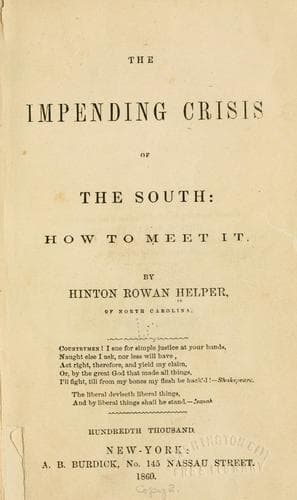
The Impending Crisis of the South: How to Meet ItHelper, Hinton Rowan
History
The Impending Crisis of the South: How to Meet It
Helper, Hinton Rowan
Slavery -- United States
A majority of the slaveholders with whom we are acquainted--and we happen
to know a few dozen more than we care to know--own, or pretend to own, at
least fifteen negroes each; some of them are the masters of more than
fifty each; and we have had the _honor (!)_ of an introduction to one man
who is represented as the owner of sixteen hundred! It is said that if all
the lands of this latter worthy were in one tract, they might be formed
into two counties of more than ordinary size; he owns plantations and
woodlands in three cotton-growing States.
The quantity of land owned by the slaveholder is generally in proportion
to the number of negroes at his "quarter;" the master of only one or two
slaves, if engaged in agriculture, seldom owns less than three hundred
acres; the holder of eight or ten slaves usually owns from a thousand to
fifteen hundred acres; five thousand acres are not unfrequently found in
the possession of the master of fifty slaves; while in Columbia, South
Carolina, about twelve months ago, a certain noted slaveholder was pointed
out to us, and reported as the owner of nearly two hundred thousand acres
in the State of Mississippi. How the great mass of illiterate poor whites,
a majority of whom are the indescribably wretched tenants of these
slavocratic landsharks, are specially imposed upon and socially outlawed,
we shall, if we have time and space, take occasion to explain in a
subsequent chapter.
Thus far, in giving expression to our sincere and settled opinions, we
have endeavored to show, in the first place, that slavery is a great
moral, social, civil, and political evil--a dire enemy to true wealth and
national greatness, and an atrocious crime against both God and man; and,
in the second place, that it is a paramount duty which we owe to heaven,
to the earth, to America, to humanity, to our posterity, to our
consciences, and to our pockets, to adopt effectual and judicious measures
for its immediate abolition. The questions now arise, How can the evil be
averted? What are the most prudent and practical means that can be devised
for the abolition of slavery? In the solution of these problems it becomes
necessary to deal with a multiplicity of stubborn realities. And yet, we
can see no reason why North Carolina, in her sovereign capacity, may not,
with equal ease and success, do what forty-five other States of the world
have done within the last forty-five years. Nor do we believe any good
reason exists why Virginia should not perform as great a deed in 1859 as
did New-York in 1799. Massachusetts abolished slavery in 1780; would it
not be a masterly stroke of policy in Tennessee, and every other slave
State, to abolish it in or before 1860?
Public-domain text, read in full here on John Shaqi.
Reviews
Reviews
No reviews yet
Be the first to share your thoughts on this work.
Elsewhere in the archive
Join the Discussion
Join the discussion
Sign in to leave a comment or review.
Sign InorCreate an account