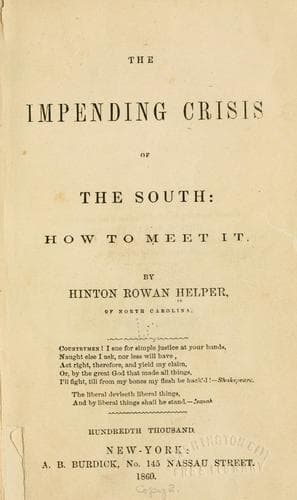
The Impending Crisis of the South: How to Meet ItHelper, Hinton Rowan
History
The Impending Crisis of the South: How to Meet It
Helper, Hinton Rowan
Slavery -- United States
"The non-slaveholding whites of the South, being not less than
seven-tenths of the whole number of whites, would seem to be entitled
to some enquiry into their actual condition; and especially, as they
have no real political weight or consideration in the country, and
little opportunity to speak for themselves. I have been for twenty
years a reader of Southern newspapers, and a reader and hearer of
Congressional debates; but, in all that time, I do not recollect ever
to have seen or heard these non-slaveholding whites referred to by
Southern 'gentlemen,' as constituting any part of what they call
'_the South_.' When the rights of the South, or its wrongs, or its
policy, or its interests, or its institutions, are spoken of,
reference is always intended to the rights, wrongs, policy,
interests, and institutions of the three hundred and forty-seven
thousand slaveholders. Nobody gets into Congress from the South but
by their direction; nobody speaks at Washington for any Southern
interest except theirs. Yet there is, at the South, quite another
interest than theirs; embracing from two to three times as many white
people; and, as we shall presently see, entitled to the deepest
sympathy and commiseration, in view of the material, intellectual,
and moral privations to which it has been subjected, the degradation
to which it has already been reduced, and the still more fearful
degradation with which it is threatened by the inevitable operation
of existing causes and influences."
The following extract, from a paper on "Domestic Manufactures in the South
and West," published by M. Tarver, of Missouri, may be appropriately
introduced in this connection:--
"The non-slaveholders possess, generally, but very small means, and
the land which they possess is almost universally poor, and so
sterile that a scanty subsistence is all that can be derived from
its cultivation; and the more fertile soil, being in the possession
of the slaveholders, must ever remain out of the power of those who
have none. This state of things is a great drawback, and bears
heavily upon and depresses the moral energies of the poorer classes.
The acquisition of a respectable position in the scale of wealth
appears so difficult, that they decline the hopeless pursuit, and
many of them settle down into habits of idleness, and become the
almost passive subjects of all its consequences. And I lament to say
that I have observed of late years, that an evident deterioration is
taking place in this part of the population, the younger portion of
it being less educated, less industrious, and in every point of view
less respectable than their ancestors."
Equally worthy of attention is the testimony of Gov. Hammond, of South
Carolina, who says:--
Public-domain text, read in full here on John Shaqi.
Reviews
Reviews
No reviews yet
Be the first to share your thoughts on this work.
Elsewhere in the archive
Join the Discussion
Join the discussion
Sign in to leave a comment or review.
Sign InorCreate an account