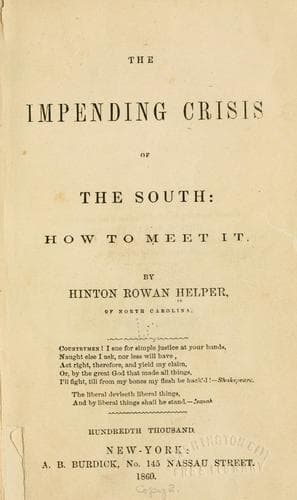
The Impending Crisis of the South: How to Meet ItHelper, Hinton Rowan
History
The Impending Crisis of the South: How to Meet It
Helper, Hinton Rowan
Slavery -- United States
It is not too late, however, for the Democratic party to secure to itself
a pure renown and an almost certain perpetuation of its power. Let it at
once discard the worship of slavery, and do earnest battle for the
principles of freedom, and it will live victoriously to a period far in
the future. On the other hand, if it does not soon repudiate the fatal
heresies which it has incorporated into its creed, its doom will be
inevitable. Until the black flag entirely disappears from its array, we
warn the non-slaveholders of the South to repulse and keep it at a
distance, as they would the emblazoned skull and cross-bones that flout
them from the flag of the pirate.
With regard to the sophistical reasoning which teaches that abolitionists,
before abolishing slavery, should compensate the slaveholders for all or
any number of the negroes in their possession, we have, perhaps, said
quite enough; but wishing to brace our arguments, in every important
particular, with unequivocal testimony from men whom we are accustomed to
regard as models of political sagacity and integrity--from Southern men as
far as possible--we herewith present an extract from a speech delivered in
the Virginia House of Delegates, January 20, 1832, by Charles James
Faulkner, whose sentiments, as then and there expressed, can hardly fail
to find a response in the heart of every intelligent, upright man:--
"But, Sir, it is said that society having conferred this property on
the slaveholder, it cannot _now_ take it from him without an adequate
compensation, by which is meant full value. I may be singular in the
opinion, but I defy the legal research of the House to point me to a
principle recognized by the law, even in the ordinary course of its
adjudications, where the community pays for property which is
removed or destroyed because it is a nuisance, and found injurious to
that society. There is, I humbly apprehend, no such principle. There
is no obligation upon society to continue your right one moment after
it becomes injurious to the best interests of society; nor to
compensate you for the loss of that, the deprivation of which is
demanded by the safety of the State, and in which general benefit you
participate as members of the community. Sir, there is to my mind a
manifest distinction between condemning private property to be
applied to some beneficial public purpose, and condemning or removing
private property which is ascertained to be a positive wrong to
society. It is a distinction which pervades the whole genius of the
law; and is founded upon the idea, that any man who holds property
injurious to the peace of that society of which he is a member,
thereby violates the condition upon the observance of which his right
to the property is alone guarantied. For property of the first class
condemned, there ought to be compensation; but for property of the
Public-domain text, read in full here on John Shaqi.
Reviews
Reviews
No reviews yet
Be the first to share your thoughts on this work.
Elsewhere in the archive
Join the Discussion
Join the discussion
Sign in to leave a comment or review.
Sign InorCreate an account