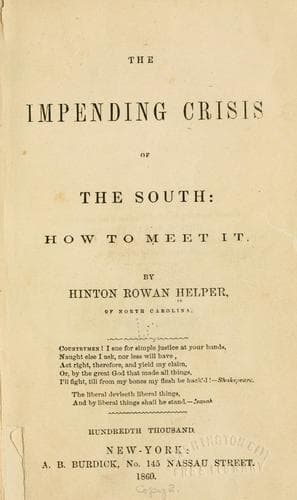
The Impending Crisis of the South: How to Meet ItHelper, Hinton Rowan
History
The Impending Crisis of the South: How to Meet It
Helper, Hinton Rowan
Slavery -- United States
From the abstract of our plan for the abolition of slavery, it will be
perceived that, so far from allowing slaveholders any compensation for
their slaves, we are, and we think justly, in favor of imposing on them a
tax of sixty dollars for each and every negro now in their possession, as
also for each and every one that shall be born to them between now and the
4th of July, 1863; after which time, we propose that they shall be taxed
forty dollars per annum, annually, for every person by them held in
slavery, without regard to age, sex, color, or condition--the money, in
both instances, to be used for the sole advantage of the slaves. As an
addendum to this proposition, we would say that, in our opinion, if
slavery is not totally abolished by the year 1869, the annual tax ought to
be increased from forty to one hundred dollars; and furthermore, that if
the institution does not then almost immediately disappear under the onus
of this increased taxation, the tax ought in the course of one or two
years thereafter, to be augmented to such a degree as will, in harmony
with other measures, prove an infallible death-blow to slavery on or
before the 4th of July, 1876.
At once let the good and true men of this country, the patriot sons of the
patriot fathers, determine that the sun which rises to celebrate the
centennial anniversary of our national independence, shall not set on the
head of any slave within the limits of our Republic. Will not the
non-slaveholders of the North, of the South, of the East, and of the West,
heartily, unanimously sanction this proposition? Will it not be cheerfully
indorsed by many of the slaveholders themselves? Will any _respectable_
man enter a protest against it? On the 4th of July, 1876--sooner, if we
can--let us make good, at least so far as we are concerned, the
Declaration of Independence, which was proclaimed in Philadelphia on the
4th of July, 1776--that "all men are endowed by their Creator with certain
inalienable rights; that among these, are life, liberty, and the pursuit
of happiness; that to secure these rights, governments are instituted
among men, deriving their just powers from the consent of the governed;
that whenever any form of government becomes destructive of these ends, it
is the right of the people to alter or to abolish it, and to institute a
new government, laying its foundation on such principles, and organizing
its powers in such form, as to them shall seem most likely to effect their
safety and happiness." In purging our land of the iniquity of negro
slavery, we will only be carrying on the great work that was so
successfully commenced by our noble sires of the Revolution; some future
generation may possibly complete the work by annulling the last and least
form of oppression.
Public-domain text, read in full here on John Shaqi.
Reviews
Reviews
No reviews yet
Be the first to share your thoughts on this work.
Elsewhere in the archive
Join the Discussion
Join the discussion
Sign in to leave a comment or review.
Sign InorCreate an account