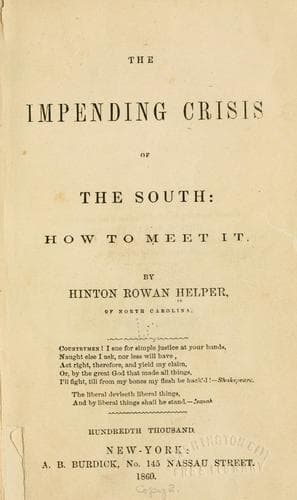
The Impending Crisis of the South: How to Meet ItHelper, Hinton Rowan
History
The Impending Crisis of the South: How to Meet It
Helper, Hinton Rowan
Slavery -- United States
"With unfeigned respect and regard, and as sincere a deprecation on
the extension of slavery and its horrors, as any other man, be him
whom he may, I am your friend, in the literal sense of that much
abused word. I say much abused, because it is applied to the leagues
of vice and avarice and ambition, instead of good will toward man
from love of him who is the Prince of Peace."
While in Congress, he said:--
"Sir, I envy neither the heart nor the head of that man from the
North who rises here to defend slavery on principle."
It is well known that he emancipated all his negroes. The following lines
from his will are well worth perusing and preserving:--
"I give to my slaves their freedom, to which my conscience tells me
they are justly entitled. It has a long time been a matter of the
deepest regret to me that the circumstances under which I inherited
them, and the obstacles thrown in the way by the laws of the land,
have prevented my emancipating them in my life-time, which it is my
full intention to do in case I can accomplish it."
THOMAS M. RANDOLPH.
In an address to the Virginia Legislature, in 1820, Gov. Randolph said:--
"We have been far outstripped by States to whom nature has been far
less bountiful. It is painful to consider what might have been, under
other circumstances, the amount of general wealth in Virginia."
THOMAS JEFFERSON RANDOLPH.
In 1832, Mr. Randolph, of Albemarle, in the Legislature of Virginia, used
the following most graphic and emphatic language:--
"I agree with gentlemen in the necessity of arming the State for
internal defence. I will unite with them in any effort to restore
confidence to the public mind, and to conduce to the sense of the
safety of our wives and our children. Yet, Sir, I must ask upon whom
is to fall the burden of this defence? Not upon the lordly masters of
their hundred slaves, who will never turn out except to retire with
their families when danger threatens. No, Sir; it is to fall upon the
less wealthy class of our citizens, chiefly upon the
non-slaveholder. I have known patrols turned out when there was not a
slaveholder among them; and this is the practice of the country. I
have slept in times of alarm quiet in bed, without having a thought
of care, while these individuals, owning none of this property
themselves, were patrolling under a compulsory process, for a
pittance of seventy-five cents per twelve hours, the very curtilage
of my house, and guarding that property which was alike dangerous to
them and myself. After all, this is but an expedient. As this
population becomes more numerous, it becomes less productive. Your
guard must be increased, until finally its profits will not pay for
the expense of its subjection. Slavery has the effect of lessening
the free population of a country.
Public-domain text, read in full here on John Shaqi.
Reviews
Reviews
No reviews yet
Be the first to share your thoughts on this work.
Elsewhere in the archive
Join the Discussion
Join the discussion
Sign in to leave a comment or review.
Sign InorCreate an account