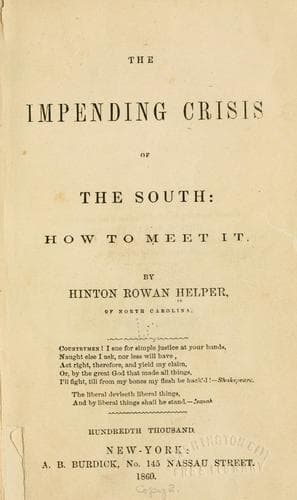
The Impending Crisis of the South: How to Meet ItHelper, Hinton Rowan
History
The Impending Crisis of the South: How to Meet It
Helper, Hinton Rowan
Slavery -- United States
"I suppose it does not follow because slavery is endeavoring to
modify the great dicta of our fathers, that cotton and free labor are
incompatible. In the extreme South, at New Orleans, the laboring
men--the stevedores and hackmen on the levee, where the heat is
intensified by the proximity of the red brick buildings, are all
white men, and they are in the full enjoyment of health. But how
about cotton? I am informed by a friend of mine--himself a
slaveholder, and therefore good authority--that in Northwestern
Texas, among the German settlements, who, true to their national
instincts, will not employ the labor of a slave--they produce more
cotton to the acre, and of a better quality, and selling at prices
from a cent to a cent and a half a pound higher than that produced by
slave labor. This is an experiment that illustrates what I have
always held, that whatever is right is expedient."
THE VOICE OF BENTON.
In his "Thirty Years' View," Thomas H. Benton says:--
"My opposition to the extension of slavery dates further back than
1844--forty years further back; and as this is a suitable time for a
general declaration, and a sort of general conscience delivery, I
will say that my opposition to it dates from 1804, when I was a
student at law in the State of Tennessee, and studied the subject of
African slavery in an American book--a Virginia book--Tucker's
edition of Blackstone's Commentaries."
Again, in a speech delivered in St. Louis, on the 3rd of November, 1856,
he says:--
"I look at white people, and not at black ones; I look to the peace
and reputation of the race to which I belong. I look to the peace of
this land--the world's last hope for a free government on the earth.
One of the occasions on which I saw Henry Clay rise higher than I
thought I ever saw him before, was when in the debate on the
admission of California, a dissolution was apprehended if slavery was
not carried into this Territory, where it never was. Then Mr. Clay,
rising, loomed colossally in the Senate of the United States, as he
rose declaring that for no earthly purpose, no earthly object, could
he carry slavery into places where it did not exist before. It was a
great and proud day for Mr. Clay, towards the latter days of his
life, and if an artist could have been there to catch his expression
as he uttered that sentiment, with its reflex on his face, and his
countenance beaming with firmness of purpose, it would have been a
glorious moment in which to transmit him to posterity--his
countenance all alive and luminous with the ideas that beat in his
bosom. That was a proud day. I could have wished that I had spoken
the same words. I speak them now, telling you they were his, and
adopting them as my own."
THE VOICE OF MASON.
Public-domain text, read in full here on John Shaqi.
Reviews
Reviews
No reviews yet
Be the first to share your thoughts on this work.
Elsewhere in the archive
Join the Discussion
Join the discussion
Sign in to leave a comment or review.
Sign InorCreate an account