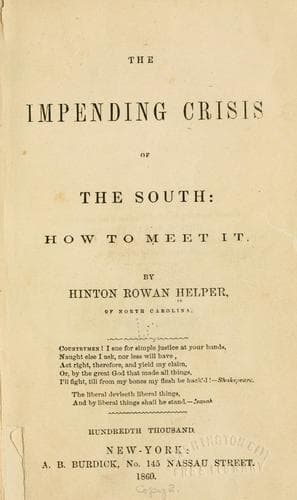
The Impending Crisis of the South: How to Meet ItHelper, Hinton Rowan
History
The Impending Crisis of the South: How to Meet It
Helper, Hinton Rowan
Slavery -- United States
"The fact must be obvious to the far-reaching minds of our Statesmen,
that unless some means of relief be devised, some channel afforded,
by which the South can, when the time comes, get rid of the excess of
her slave population, she will be ultimately found with regard to
this institution, in the predicament of the man with the wolf by the
ears; too dangerous to hold on any longer, and equally dangerous to
let go. To our mind, the event is as certain to happen as any event
which depends on the contingencies of the future, viz.: that unless
means be devised for gradually relieving the slave States from the
undue pressure of this class upon them--unless some way be opened by
which they may be rid of their surplus black population--the time
will come--it may not be in the next nor in the succeeding
generation--but, sooner or later, come it will, and come it
must--when the two races will join in the death struggle for the
mastery."
THE VOICE OF BIRNEY.
James G. Birney, of Kentucky, under whom the Abolitionists first became a
National Party, and for whom they voted for President in 1844, giving him
66,304 votes, says:
"We have so long practiced injustice, adding to it hypocrisy, in the
treatment of the colored race, both negroes and Indians, that we
begin to regard injustice as an element--a chief element--the chief
element of our government. But no government which admits injustice
as an element can be a harmonious one or a permanent one. Harmony is
the antagonist of injustice, ever has been, and ever will be; that
is, so long as injustice lasts, which cannot always be, for it is a
lie, a semblance, therefore, perishable. True, from the imperfection
of man, his ambition and selfishness, injustice often finds its way
incidentally into the administration of public affairs, and maintains
its footing a long time before it is cast out by the legitimate
elements of government."
"Our slave States, especially the more southern of them, in which the
number of slaves is greater, and in which, of course the sentiment of
injustice is stronger than in the more northern ones, are to be
placed on the list of decaying communities. To a philosophic
observer, they seem to be falling back on the scale of civilization.
Even at the present point of retrogression, the cause of civilization
and human improvement would lose nothing by their annihilation."
THE VOICE OF DELAWARE.
Strong anti-slavery sentiment had become popular in Delaware as early as
1785. With Maryland and Missouri, it may now be ranked as a semi-slave
State. Mr. McLane, a member of Congress from this State in 1825, said:--
Public-domain text, read in full here on John Shaqi.
Reviews
Reviews
No reviews yet
Be the first to share your thoughts on this work.
Elsewhere in the archive
Join the Discussion
Join the discussion
Sign in to leave a comment or review.
Sign InorCreate an account