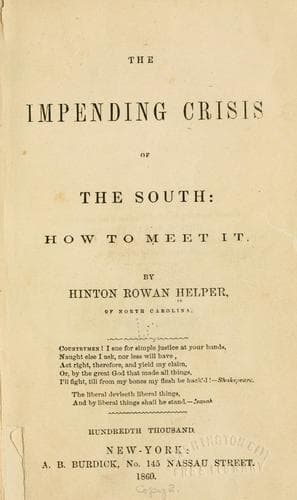
The Impending Crisis of the South: How to Meet ItHelper, Hinton Rowan
History
The Impending Crisis of the South: How to Meet It
Helper, Hinton Rowan
Slavery -- United States
"In this State the legislature have considered slaves as reasonable
and accountable beings; and it would be a stigma upon the character
of the State, and a reproach to the administration of justice, if the
life of a slave could be taken with impunity, or if he could be
murdered in cold blood, without subjecting the offender to the
highest penalty known to the criminal jurisprudence of the country.
Has the slave no rights, because he is deprived of his freedom? He is
still a human being, and possesses all those rights of which he is
not deprived by the positive provisions of the law. The right of the
master exists not by force of the law of nature or nations, but by
virtue only of the positive law of the State."
The Hon. Judge Ruffin, of North Carolina, says:--
"Arguments drawn from the well-established principles, which confer
and restrain the authority of the parent over the child, the tutor
over the pupil, the master over the apprentice, have been pressed on
us. The Court does not recognize their application; there is no
likeness between the cases; they are in opposition to each other, and
there is an impassable gulf between them. The difference is that
which exists between freedom and slavery, and a greater cannot be
imagined. In the one, the end in view is the happiness of the youth,
born to equal rights with that governor on whom the duty devolves of
training the young to usefulness, in a station which he is afterwards
to assume among freemen. To such an end, and with such a subject,
moral and intellectual instruction seem the natural means, and, for
the most part, they are found to suffice. Moderate force is
superadded only to make the others effectual. If that fail, it is
better to leave the party to his own headstrong passions, and the
ultimate correction of the law, than to allow it to be immoderately
inflicted by a private person. With slavery it is far otherwise. The
end is the profit of the master, his security, and the public safety;
the subject, one doomed, in his own person and his posterity, to live
without knowledge, and without the capacity to make anything his own,
and to toil that another may reap the fruits. What moral
considerations shall be addressed to such a being to convince him,
what it is impossible but that the most stupid must feel and know can
never be true, that he is thus to labor upon a principle of natural
duty, or for the sake of his own personal happiness? Such services
can only be expected from one who has no will of his own; who
surrenders his will in implicit obedience to that of another. Such
obedience is the consequence only of uncontrolled authority over the
body. There is nothing else which can operate to produce the effect.
The power of the master must be absolute to render the submission of
Public-domain text, read in full here on John Shaqi.
Reviews
Reviews
No reviews yet
Be the first to share your thoughts on this work.
Elsewhere in the archive
Join the Discussion
Join the discussion
Sign in to leave a comment or review.
Sign InorCreate an account