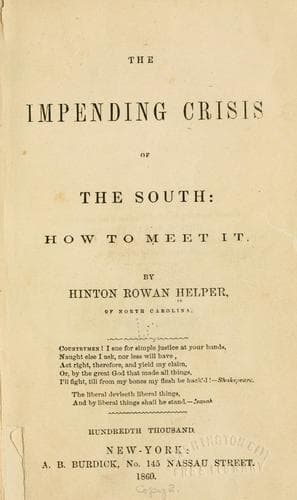
The Impending Crisis of the South: How to Meet ItHelper, Hinton Rowan
History
The Impending Crisis of the South: How to Meet It
Helper, Hinton Rowan
Slavery -- United States
John Jay, first Chief Justice of the United States under the Constitution
of 1789, in a letter to the Hon. Elias Boudinot, dated Nov. 17, 1819,
says:--
"Little can be added to what has been said and written on the subject
of slavery. I concur in the opinion that it ought not to be
introduced nor permitted in any of the new States, and that it ought
to be gradually diminished and finally abolished in all of them.
"To me, the constitutional authority of the Congress to prohibit the
migration and importation of slaves into any of the States does not
appear questionable.
"The first article of the Constitution specifies the legislative
powers committed to the Congress. The 9th section of that article has
these words: 'The _migration_ or _importation_ of such persons as any
of the _now-existing_ States shall think proper to admit, shall not
be prohibited by the Congress prior to the year 1808, but a tax or
duty may be imposed on such importation, not exceeding ten dollars
for each person.'
"I understand the sense and meaning of this clause to be, that the
power of the congress, although competent to prohibit such migration
and importation, was to be exercised with respect to the _then_
existing States, and them only, until the year 1808, but the Congress
were at liberty to make such prohibitions as to any _new_ State,
which might in the _mean_ time be established. And further, that from
and after _that_ period, they were authorized to make such
prohibitions as to _all_ the States, whether _new_ or _old_.
"It will, I presume, be admitted, that slaves were the persons
intended. The word slaves was avoided, probably on account of the
existing toleration of slavery, and its discordancy with the
principles of the Revolution, and from a consciousness of its being
repugnant to the following positions in the Declaration of
Independence: 'We hold these truths to be self-evident: that all men
are created equal; that they are endowed by their Creator with
certain inalienable rights; that among these are life, liberty, and
the pursuit of happiness.'"
In a previous letter, written from Spain, whither he had been appointed as
minister plenipotentiary, he says, speaking of the abolition of slavery:--
"Till America comes into this measure, her prayers to Heaven will be
impious. This is a strong expression, but it is just. I believe that
God governs the world, and I believe it to be a maxim in His, as in
our Courts, that those who ask for equity ought to do it."
WILLIAM JAY.
The Hon. Wm. Jay, a noble son of Chief Justice John Jay, says:--
Public-domain text, read in full here on John Shaqi.
Reviews
Reviews
No reviews yet
Be the first to share your thoughts on this work.
Elsewhere in the archive
Join the Discussion
Join the discussion
Sign in to leave a comment or review.
Sign InorCreate an account