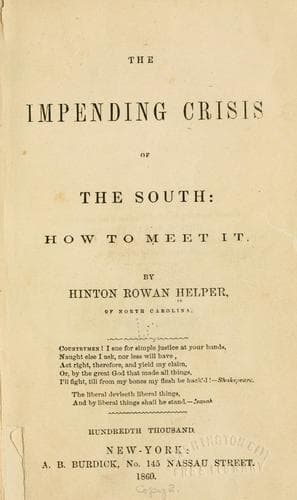
The Impending Crisis of the South: How to Meet ItHelper, Hinton Rowan
History
The Impending Crisis of the South: How to Meet It
Helper, Hinton Rowan
Slavery -- United States
Thus, in the last five chapters inclusive, have we introduced a mass of
anti-slavery arguments, human and divine, that will stand, irrefutable and
convincing, as long as the earth itself shall continue to revolve in its
orbit. Aside from unaffected truthfulness and candor, no merit is claimed
for anything we have said on our own account. With the best of motives,
and in the language of nature more than that of art, we have simply given
utterance to the honest convictions of our heart--being impelled to it by
a long-harbored and unmistakable sense of duty which grew stronger and
deeper as the days passed away.
If half the time which has been spent in collecting and arranging these
testimonies had been occupied in the composition of original matter, the
weight of paper and binding and the number of pages would have been much
greater, but the value and the effect of the contents would have been far
less. From the first, our leading motive has been to convince our
fellow-citizens of the South, non-slaveholders and slaveholders, that
slavery, whether considered in all its bearings, or, setting aside the
moral aspect of the question, and looking at it in only a pecuniary point
of view, is impolitic, unprofitable, and degrading; how well, thus far, we
have succeeded in our undertaking, time will, perhaps, fully disclose.
In the words of a contemporaneous German writer, whose language we readily
and heartily endorse, "It is the shame of our age that argument is needed
against slavery." Taking things as they are, however, argument being
needed, we have offered it; and we have offered it from such sources as
will, in our honest opinion, confound the devil and his incarnate
confederates.
These testimonies, culled from the accumulated wisdom of nearly six
thousand centuries, beginning with the great and good men of our own time,
and running back through distant ages to Saint Paul, Saint John, and Saint
Luke, to Cicero, Plato, and Socrates, to Solomon, David, and Moses, and
even to the Deity himself, are the pillars of strength and beauty upon
which the popularity of our work will, in all probability, be principally
based. If the ablest writers of the Old Testament; if the eloquent
prophets of old; if the renowned philosophers of Greece and Rome; if the
heavenly-minded authors and compilers of the New Testament; if the
illustrious poets and prose-writers, heroes, statesmen, sages of all
nations, ancient and modern; if God himself and the hosts of learned
ministers whom he has commissioned to proclaim his word--if all these are
wrong, then we are wrong; on the other hand, however, if they are right,
we are right; for, in effect, we only repeat and endeavor to enforce their
precepts.
Public-domain text, read in full here on John Shaqi.
Reviews
Reviews
No reviews yet
Be the first to share your thoughts on this work.
Elsewhere in the archive
Join the Discussion
Join the discussion
Sign in to leave a comment or review.
Sign InorCreate an account