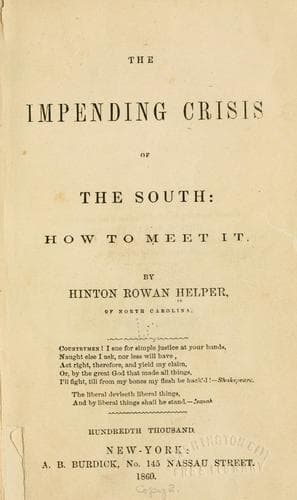
The Impending Crisis of the South: How to Meet ItHelper, Hinton Rowan
History
The Impending Crisis of the South: How to Meet It
Helper, Hinton Rowan
Slavery -- United States
This last table, compiled from the 116th page of the Compendium of the
Seventh Census, shows, in a most lucid and startling manner, how negroes,
slavery and slaveholders are driving the native non-slaveholding whites
away from their homes, and keeping at a distance other decent people. From
the South the tide of emigration still flows in a westerly and
north-westerly direction, and it will continue to do so until slavery is
abolished. The following remarks, which we extract from an editorial
article that appeared in the Memphis (Tenn.) _Bulletin_ near the close of
the year 1856, are worth considering in this connection:--
"We have never before observed so large a number of immigrants going
westward as are crossing the river at this point daily, the two ferry
boats--sometimes three--going crowded from early morn until the boats
cease making their trips at night. It is no uncommon sight to see
from twenty to forty wagons encamped on the bluff for the night,
notwithstanding there has been a steady stream going across the river
all day, and yet the cry is, still they come."
About the same time the Cassville (Geo.) _Standard_ spoke with surprise of
the multitude of emigrants crowding the streets of that town bound for the
far West.
Prof. B. S. Hedrick, late of Chapel Hill, North Carolina, says:--
"Of my neighbors, friends and kindred, nearly one-half have left the
State since I was old enough to remember. Many is the time I have
stood by the loaded emigrant wagon, and given the parting hand to
those whose faces I was never to look upon again. They were going to
seek homes in the free West, knowing, as they did, that free and
slave labor could not both exist and prosper in the same community.
If any one thinks that I speak without knowledge, let him refer to
the last census. He will there find that in 1850 there were
fifty-eight thousand native North Carolinians living in the free
States of the West--thirty-three-thousand in Indiana alone. There
were, at the same time, one hundred and eighty thousand Virginians
living in the free States. Now, if these people were so much in love
with the 'institution,' why did they not remain where they could
enjoy its blessings?
"From my knowledge of the people of North Carolina, I believe that
the majority of them who will go to Kansas during the next five
years, would prefer that it should be a free State. I am sure that if
I were to go there I should vote to exclude slavery."
Public-domain text, read in full here on John Shaqi.
Reviews
Reviews
No reviews yet
Be the first to share your thoughts on this work.
Elsewhere in the archive
Join the Discussion
Join the discussion
Sign in to leave a comment or review.
Sign InorCreate an account