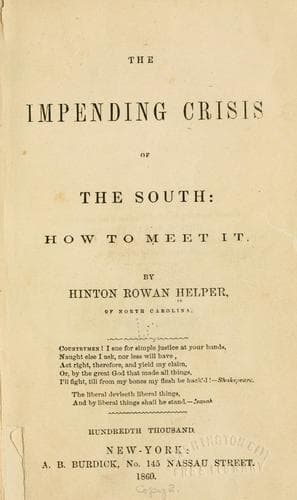
The Impending Crisis of the South: How to Meet ItHelper, Hinton Rowan
History
The Impending Crisis of the South: How to Meet It
Helper, Hinton Rowan
Slavery -- United States
Whether Southern merchants ever think of the numerous ways in which they
contribute to the aggrandizement of the North, while, at the same time,
they enervate and dishonor the South, has, for many years, with us, been a
matter of more than ordinary conjecture. If, as it would seem, they have
never yet thought of the subject, it is certainly desirable that they
should exercise their minds upon it at once. Let them scrutinize the
workings of Southern money after it passes north of Mason and Dixon's
line. Let them consider how much they pay to Northern railroads and
hotels, how much to Northern merchants and shop-keepers, how much to
Northern shippers and insurers, how much to Northern theatres, newspapers,
and periodicals. Let them also consider what disposition is made of it
after it is lodged in the hands of the North. Is not the greater part of
it paid out to Northern manufacturers, mechanics, and laborers, for the
very articles which are purchased at the North--and to the extent that
this is done, are not Northern manufacturers, mechanics, and laborers
directly countenanced and encouraged, while at the same time, Southern
manufacturers, mechanics, and laborers, are indirectly abased, depressed,
and disabled? It is, however, a matter of impossibility, on these small
pages, to notice or enumerate all the methods in which the money we
deposit in the North is made to operate against us; suffice it to say that
it is circulated and expended there, among all classes of the people, to
the injury and impoverishment of almost every individual in the South. And
yet, our cousins of the North are not, by any means, blameworthy for
availing themselves of the advantages which we have voluntarily yielded to
them. They have shown their wisdom in growing great at our expense, and we
have shown our folly in allowing them to do so. Southern merchants,
slaveholders, and slave-breeders, should be the objects of our censure;
they have desolated and impoverished the South; they are now making
merchandize of the vitals of their country; patriotism is a word nowhere
recorded in their vocabulary; town, city, country--they care for neither;
with them, self is always paramount to every other consideration.
Having already compared slavery with freedom in the States, we will now
compare it with freedom in the cities. From every person as yet
unconvinced of the despicableness of slavery, we respectfully ask
attention to the following letters, which fully explain themselves:--
FINANCE DEPARTMENT COMPTROLLER'S OFFICE,}
New-York, February 17th, 1857. }
H. R. HELPER, ESQ.,
_Dear Sir_:--
Your letter to Mayor Wood has been handed to me for an answer, which
I take pleasure in giving as follows:
The last assessment of property in this city was made in August,
1856.
The value of all the real and personal property in the city,
according to that assessment, is $511,740,492.
Public-domain text, read in full here on John Shaqi.
Reviews
Reviews
No reviews yet
Be the first to share your thoughts on this work.
Elsewhere in the archive
Join the Discussion
Join the discussion
Sign in to leave a comment or review.
Sign InorCreate an account