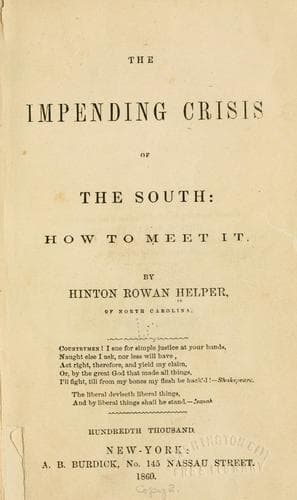
The Impending Crisis of the South: How to Meet ItHelper, Hinton Rowan
History
The Impending Crisis of the South: How to Meet It
Helper, Hinton Rowan
Slavery -- United States
"We question if any other community, certainly no other in the United
States of America, have made greater exertions to resuscitate the
trade of Norfolk than the mercantile portion of the inhabitants; in
proof of which nineteen-twentieths of those engaged in foreign
commerce have terminated in their insolvency, the principal cause of
which has been in the unrelenting hostility, to this day, from the
commencement of the present century, of the Virginia Legislature,
with the co-operation of at least the commercial portions of the
citizens of Richmond, Petersburg and Portsmouth."
How it is, in this enlightened age, that men of ordinary intelligence can
be so far led into error as to suppose that commerce, or any other noble
enterprise, can be established and successfully prosecuted under the
dominion of slavery, is, to us, one of the most inexplicable of mysteries.
"Commercial" Conventions, composed of the self-titled lordlings of
slavery--Generals, Colonels, Majors, Captains, etcaetera--may act out their
annual programmes of farcical nonsense from now until doomsday; but they
will never add one iota to the material, moral, or mental interests of
the South,--never can, until their ebony idol shall have been utterly
demolished.
BALTIMORE--PAST, PRESENT, AND FUTURE.
We are indebted to the Baltimore _Patriot_ for the following interesting
sketch of the Monumental City as it was, and as it is, and as it may be:--
"The population of Baltimore in 1790 was 13,503; in 1800, 15,514; in
1810, 35,583; in 1820, 62,738; in 1830, 80,625; in 1840, 110,313; in
1850, 169,054. The increase of inhabitants within two particular
decades, will be found, by reference to the above table, to be
remarkable. Between 1800 and 1810, the population nearly doubled
itself; between 1840 and 1850, the increase was two-thirds; and for
the past five years, the numerical extension of our population has
been even more rapid than during the previous decade. We may safely
assume that Baltimore contains at the present time not less than
250,000 inhabitants. But the increase in the manufactured products of
the State, as shown by the report of the Secretary of the Treasury,
is a matter of even greater astonishment. The statistical tables of
1840 estimate the aggregate value of the manufactures of Maryland at
$13,509,636--_thirteen million five hundred and nine thousand six
hundred and thirty-six dollars_. In 1850, the value of the articles
manufactured within the limits of the State amounted to
$32,593,635--_thirty-two million five hundred and ninety-three
thousand six hundred and thirty-five dollars_! A signal proof that
the wealth of the State has increased with even far greater rapidity
than its population. A quarter of a century ago, the sum of our
manufactures did not much exceed five millions of dollars per annum.
Public-domain text, read in full here on John Shaqi.
Reviews
Reviews
No reviews yet
Be the first to share your thoughts on this work.
Elsewhere in the archive
Join the Discussion
Join the discussion
Sign in to leave a comment or review.
Sign InorCreate an account