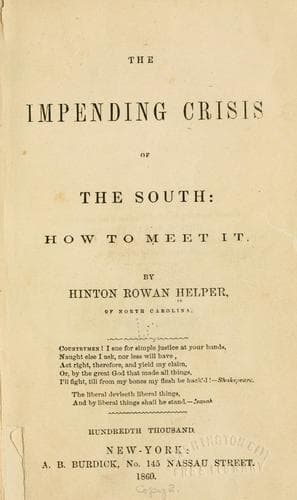
The Impending Crisis of the South: How to Meet ItHelper, Hinton Rowan
History
The Impending Crisis of the South: How to Meet It
Helper, Hinton Rowan
Slavery -- United States
Take any common map of the United States and rule an air line across
it from Baltimore to St. Louis, and midway between the two it will
strike Cincinnati--the great inland centre of trade--traversing at
the same time those wonderfully fertile valleys which lie between the
latter point and the Mississippi river. Now let it be remembered that
since the introduction of railways fluvial navigation has been, to a
considerable extent, superseded by inland transport, because of the
greater speed and certainty of the latter. Let it be remembered also
that the migration westward is incessantly going on, and that with
every farm opened within striking distance of a great arterial
railway, or its anastomosing branches, a certain amount of freight
must find its way to the seaboard markets, while the demand for
manufactured products, and for domestic or foreign commodities, in
exchange for breadstuffs or raw material, must necessarily increase;
thereby adding greatly to the prosperity of the commercial centre
towards which articles of export tend, and from which imports in
return are drawn. It would be difficult to estimate the value of what
this trade will be fifty years hence, or what the population of
Baltimore, situated as she is, will by that time have become.
Reasoning from causes to effects, and presuming that ordinary
perseverance will be used in promoting the interests of our city,
industrially and commercially, we are justified in believing that its
progress must be in an accelerated ratio, and that there are those
now living who will look back with surprise and wonder at its growth
and magnitude, as we have done while comparing its present aspect
with that which it exhibited within our own memory."
It is a remarkable fact, but one not at all surprising to those whose
philosophy leads them to think aright, that Baltimore and St. Louis, the
two most prosperous cities in the slave States, have fewer slaves in
proportion to the aggregate population than any other city or cities in
the South. While the entire population of the former is now estimated at
250,000, and that of the latter at 140,000--making a grand total of
390,000 in the two cities, less than 6,000 of this latter number are
slaves; indeed, neither city is cursed with half the number of 6,000.
In 1850, there were only 2,946 slaves in Baltimore, and 2,656 in St.
Louis--total in the two cities 5,602; and in both places, thank Heaven,
this heathenish class of the population was rapidly decreasing. The census
of 1860 will, in all probability, show that the two cities are entirely
exempt from slaves and slavery; and that of 1870 will, we prayerfully
hope, show that the United States at large, at that time, will have been
wholly redeemed from the unspeakable curse of human bondage.
Public-domain text, read in full here on John Shaqi.
Reviews
Reviews
No reviews yet
Be the first to share your thoughts on this work.
Elsewhere in the archive
Join the Discussion
Join the discussion
Sign in to leave a comment or review.
Sign InorCreate an account