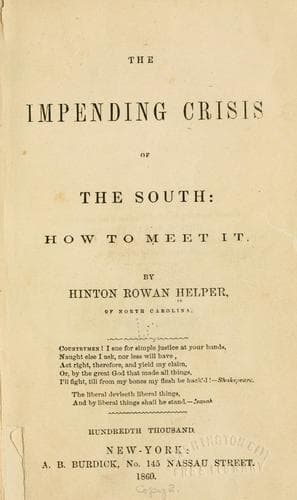
The Impending Crisis of the South: How to Meet ItHelper, Hinton Rowan
History
The Impending Crisis of the South: How to Meet It
Helper, Hinton Rowan
Slavery -- United States
cheaply from Kansas than from their present breeding-places this side
of the Alleghanies.
Whenever we draw a parallel between Northern and Southern production,
industry, thrift, wealth, the few who seek to parry the facts at all
complain that the instances are unfairly selected--that the
commercial ascendancy of the North, with the profits and facilities
thence accruing, accounts for the striking preponderance of the
North. In vain we insist that slavery is the cause of this very
commercial ascendancy--that Norfolk and Richmond and Charleston might
have been to this country what Boston, New-York and Philadelphia now
are, had not slavery spread its pall over and paralyzed the energies
of the South."
This may be regarded as a fair expression of the sentiments of a great
majority of the people north of Mason and Dixon's line. Our Northern
cousins "do not hate the South, war on the South, nor seek to ruin the
South;" on the contrary, they love our particular part of the nation, and,
like dutiful, sensible, upright men, they would promote its interests by
facilitating the abolition of slavery. Success to their efforts!
SLAVERY THOUGHTFUL--SIGNS OF CONTRITION.
The real condition of the South is most graphically described in the
following doleful admissions from the Charleston _Standard_:--
"In its every aspect our present condition is provincial. We have
within our limits no solitary metropolis of interest or ideas--no
marts of exchange--no radiating centres of opinion. Whatever we have
of genius and productive energy, goes freely in to swell the
importance of the North. Possessing the material which constitutes
two-thirds of the commerce of the whole country, it might have been
supposed that we could have influence upon the councils of foreign
States; but we are never taken into contemplation. It might have been
supposed that England, bound to us by the cords upon which depend the
existence of four millions of her subjects, would be considerate of
our feelings; but receiving her cotton from the North, it is for them
she has concern, and it is her interest and her pleasure to reproach
us. It might have been supposed, that, producing the material which
is sent abroad, to us would come the articles that are taken in
exchange for it; but to the North they go for distribution, and to us
are parcelled out the fabrics that are suited to so remote a section.
Public-domain text, read in full here on John Shaqi.
Reviews
Reviews
No reviews yet
Be the first to share your thoughts on this work.
Elsewhere in the archive
Join the Discussion
Join the discussion
Sign in to leave a comment or review.
Sign InorCreate an account