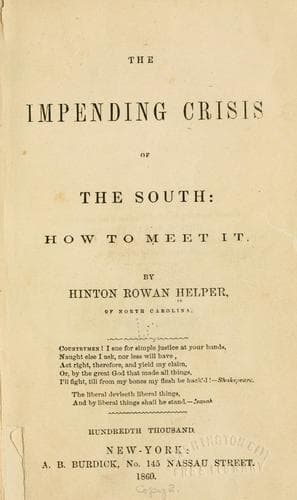
The Impending Crisis of the South: How to Meet ItHelper, Hinton Rowan
History
The Impending Crisis of the South: How to Meet It
Helper, Hinton Rowan
Slavery -- United States
The severance of the General Government from slavery.
_The_ REPEAL _of the fugitive slave law._
_The_ REPEAL _of the Nebraska Kansas Bill._
_No more slave territories._
THE PURCHASE AND MANUMISSION OF SLAVES IN THE DISTRICT OF COLUMBIA,
OR THE REMOVAL OF THE SEAT OF GOVERNMENT TO FREE TERRITORY."
Says the Baltimore _Clipper_:--
"The South is contending for, and the North against, the extension of
slavery into the territories; but we do not think that either side
would consent to dissolve the Union about the negro population--a
population which we look upon as a curse to the nation, and should
rejoice to see removed to their native clime of Africa."
The _National Era_, _one_ of the best papers in the country, published in
Washington City, D. C., says:--
"The tendency of slavery to diffuse itself, and to crowd out free
labor, was early observed by American patriots, North and South; and
Mr. Jefferson, the great apostle of Republicanism, made an effort, in
1784, to cut short the encroaching tide of barbaric despotism, by
prohibiting slavery in all the territories of the Union, down to
thirty-one degrees of latitude, which was then our Southern boundary.
His beneficent purpose failed, not for want of a decisive majority of
votes present in the Congress of the Confederation, but in
consequence of the absence of the delegates from one or two States,
which were necessary to the constitutional majority. When the subject
again came up, in 1787, Mr. Jefferson was Minister to France, and the
famous ordinance of that year was adopted, prohibiting slavery North
and West of the Ohio river. Between 1784 and 1787, the strides of
slavery westward, into Tennessee and Kentucky, had become too
considerable to admit of the policy of exclusion; and besides those
regions were then integral parts of Virginia and North Carolina, and
of course they could not be touched without the consent of those
States. In 1820, another effort was made to arrest the progress of
slavery, which threatened to monopolize the whole territory west of
the Mississippi. In the meantime the South had apostatized from the
faith of Jefferson. It had ceased to love universal liberty, and the
growing importance of the cotton culture had caused the people to
look with indifference upon the moral deformity of slavery; and, as a
matter of course, the politicians became its apologists and
defenders. After a severe struggle a compromise was agreed upon, by
which Missouri was to be admitted with slavery, which was the
immediate point in controversy; and slavery was to be excluded from
all the territory North and West of that State.
Public-domain text, read in full here on John Shaqi.
Reviews
Reviews
No reviews yet
Be the first to share your thoughts on this work.
Elsewhere in the archive
Join the Discussion
Join the discussion
Sign in to leave a comment or review.
Sign InorCreate an account