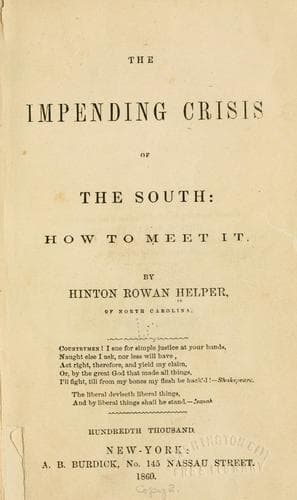
The Impending Crisis of the South: How to Meet ItHelper, Hinton Rowan
History
The Impending Crisis of the South: How to Meet It
Helper, Hinton Rowan
Slavery -- United States
We are quite conscious that the fullness and accuracy of statement which
are desirable in this chapter cannot be attained in the brief time allowed
us for its completion; but, though much will necessarily be omitted that
ought to be said, we shall endeavor to make no statement of facts which
are not well authenticated, and no inferences from the same which are not
logically true. We can only promise to do the best in our power, with the
materials at our command, to exhibit the inevitable influence of slavery
upon Southern Literature, and to demonstrate that the accursed institution
so cherished by the oligarchy, is no less prejudicial to our advancement
in letters, than it is destructive of our material prosperity.
What is the actual condition of Literature at the South? Our question
includes more than simple authorship in the various departments of
letters, from the compilation of a primary reader to the production of a
Scientific or Theological Treatise. We comprehend in it all the activities
engaged in the creation, publication, and sale of books and periodicals,
from the penny primer to the heavy folio, and from the dingy, coarse-typed
weekly paper, to the large, well-filled daily.
It were unjust to deny a degree of intellectual activity to the South. It
has produced a few good authors--a few competent editors, and a moderately
large number of clever magazinists, paragraphists, essayists and critics.
Absolutely, then, it must be conceded that the South has something that
may be called a literature; it is only when we speak of her in comparison
with the North, that we say, with a pardonably strong expression, "The
South has no literature." This was virtually admitted by more than one
speaker at the late "Southern Convention" at Savannah. Said a South
Carolina orator on that occasion: "It is important that the South _should
have_ a literature of her own, to defend her principles and her rights;" a
sufficiently plain concession that she has not, now, such a literature.
But _facts_ speak more significantly than the rounded periods of
Convention orators. Let us look at facts, then.
First, turning our attention to the periodical literature of the South, we
obtain these results: By the census of 1850, we ascertain that the entire
number of periodicals, daily, semi-weekly, weekly, semi-monthly, monthly
and quarterly, published in the slave States, including the District of
Columbia, were seven hundred and twenty-two. These had an aggregate
_yearly_ circulation of ninety-two million one hundred and sixty-seven
thousand one hundred and twenty-nine. (92,167,129). The number of
periodicals, of every class, published in the non-slaveholding States
(exclusive of California) was one thousand eight hundred and ninety-three,
with an aggregate yearly circulation of three hundred and thirty-three
million three hundred and eighty-six thousand and eighty-one.
(333,386,081).
Public-domain text, read in full here on John Shaqi.
Reviews
Reviews
No reviews yet
Be the first to share your thoughts on this work.
Elsewhere in the archive
Join the Discussion
Join the discussion
Sign in to leave a comment or review.
Sign InorCreate an account