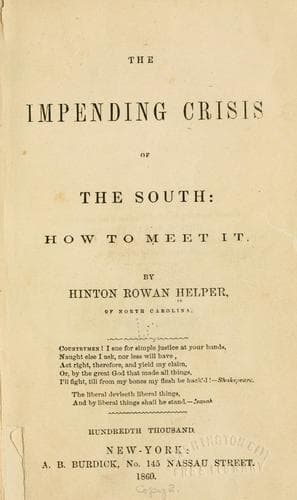
The Impending Crisis of the South: How to Meet ItHelper, Hinton Rowan
History
The Impending Crisis of the South: How to Meet It
Helper, Hinton Rowan
Slavery -- United States
Ex-Mayor Harper, whom we have found to be one of the most affable and
estimable gentlemen in the city of New-York, informed us, sometime ago,
that, though he had no means of knowing positively, he was of the opinion
that about eighty per cent. of all their publications find final
purchasers in the free States--the remainder, about twenty per cent., in
the slave States. Yet it is probable that, with one or two exceptions, no
other publishing house in the country has so large a per centage of
Southern trade.
Of the "more than three hundred houses engaged in the publication of
books," to which the writer in the "American Publishers' Circular" refers,
upwards of nine-tenths of the number are in the non-slaveholding States,
and these represent not less than ninety-nine hundredths of the whole
capital invested in the business. Baltimore has twice as many publishers
as any other Southern city; and nearly as many as the whole South beside.
The census returns of 1850 give but twenty-four publishers for the entire
South, and ten of these were in Maryland. The relative disproportion which
then existed in this branch of enterprise, between the North and the
South, still exists; or, if it has been changed at all, that change is in
favor of the North. So of all the capital, enterprise and industry
involved in the manufacture of the _material_ that enters into the
composition of books. All the paper manufactories of the South do not
produce enough to supply a single publishing house in the city of
New-York.--Perhaps "a Southern Literature" does not necessarily involve
the enterprises requisite to the _manufacture_ of books; but experience
has shown that there is a somewhat intimate relation between the author,
printer, paper-maker and publisher; in other words, that the intellectual
activity which expresses itself in books, is measurable by the mechanical
activities engaged in their manufacture.--Thus a State that is fruitful in
authors will almost necessarily be fruitful in publishers; and the number
of both classes will be proportioned to the _reading_ population. The
poverty of Southern literature is legitimately shown, therefore, in the
paucity of Southern publishers. We do not deny a high degree of cultivated
talent to the South; we are familiar with the names of her sons whose
genius has made them eminent; all that we insist upon is, that the same
accursed influence which has smitten her industrial enterprises with
paralysis, and retarded indefinitely her material advancement, has exerted
a corresponding influence upon her literature. How it has done this we
shall more fully indicate before we close the chapter.
Public-domain text, read in full here on John Shaqi.
Reviews
Reviews
No reviews yet
Be the first to share your thoughts on this work.
Elsewhere in the archive
Join the Discussion
Join the discussion
Sign in to leave a comment or review.
Sign InorCreate an account