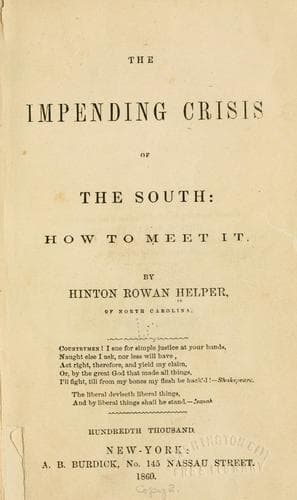
The Impending Crisis of the South: How to Meet ItHelper, Hinton Rowan
History
The Impending Crisis of the South: How to Meet It
Helper, Hinton Rowan
Slavery -- United States
There, gentlemen of the South, you have the definitions of the transitive
verb _abolish_ and its two derivative nouns, _abolition_ and
_abolitionist_; can you, with the keenest possible penetration of vision,
detect in either of these words even a tittle of the opprobrium which the
oligarchs, in their wily and inhuman efforts to enslave all working
classes irrespective of race or color, have endeavored to attach to them?
We know you cannot; abolition is but another name for patriotism, and its
other special synonyms are generosity, magnanimity, reason, prudence,
wisdom, religion, progress, justice, and humanity.
And here, by the way, we may as well explain whom we refer to when we
speak of gentlemen of the South. We say, therefore, that, deeply impressed
with the conviction that slavery is a great social and political evil, a
_sin and a crime_, in the fullest sense, whenever we speak of gentlemen of
the South, or of gentlemen anywhere, or at whatever time, or in whatever
connection we may speak of gentlemen, we seldom allude to slaveholders,
for the simple reason that, with few exceptions, we cannot conscientiously
recognize _them_ as gentlemen. It is only in those rare instances where
the crime is mitigated by circumstances over which the slaveholder has had
no control, or where he himself, convinced of the impropriety, the folly
and the wickedness of the institution, is anxious to abolish it, that we
can sincerely apply to him the sacred appellation in question--an
appellation which we would no sooner think of applying to a _pro-slavery_
slaveholder, or any other pro-slavery man, than we would think of applying
it to a border-ruffian, a thief or a murderer. Let it be understood,
however, that the rare instances of which we speak are less rare than many
persons may suppose. We are personally acquainted with several
slaveholders in North Carolina, South Carolina, Maryland and Virginia, who
have unreservedly assured us that they were disgusted with the
institution, and some of them went so far as to say they would be glad to
acquiesce in the provision of a statute which would make it obligatory on
them all to manumit their slaves, without the smallest shadow or substance
of compensation. These, we believe, are the sentiments of all the
respectable and patriotic slaveholders, who have eyes to see, and
see--ears to hear, and hear; who, perceiving the impoverishing and
degrading effects of slavery, are unwilling to entail it on their
children, and who, on account of their undeviating adherence to truth and
justice, are, like the more intelligent non-slaveholders, worthy of being
regarded as gentlemen in every sense of the term. Such slaveholders were
Washington, Jefferson, Madison, and other illustrious Virginians, who, in
the language of the great chief himself, declared it among their "_first
wishes_ to see some plan adopted by which slavery, in this country, may be
abolished by law." The words embraced within this quotation were used by
Public-domain text, read in full here on John Shaqi.
Reviews
Reviews
No reviews yet
Be the first to share your thoughts on this work.
Elsewhere in the archive
Join the Discussion
Join the discussion
Sign in to leave a comment or review.
Sign InorCreate an account