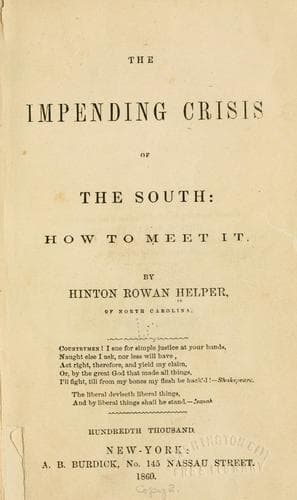
The Impending Crisis of the South: How to Meet ItHelper, Hinton Rowan
History
The Impending Crisis of the South: How to Meet It
Helper, Hinton Rowan
Slavery -- United States
The oligarchs say we cannot abolish slavery without infringing on the
right of property. Again we tell them we do not recognize property in man;
but even if we did, and if we were to inventory the negroes at quadruple,
the value of their last assessment, still, impelled by a sense of duty to
others, and as a matter of simple justice to ourselves, we, the
non-slaveholders of the South, would be fully warranted in emancipating
all the slaves at once, and that, too, without any compensation whatever
to those who claim to be their absolute masters and owners. We will
explain. In 1850, the average value per acre, of land in the Northern
States was $28,07; in the Northwestern $11,39; in the Southern $5,34; and
in the Southwestern $6,26. Now, in consequence of numerous natural
advantages, among which may be enumerated the greater mildness of climate,
richness of soil, deposits of precious metals, abundance and spaciousness
of harbors, and super-excellence of water-power, we contend that, had it
not been for slavery, the average value of land in all the Southern and
Southwestern States, would have been _at least_ equal to the average value
of the same in the Northern States. We conclude, therefore, and we think
the conclusion is founded on principles of equity, that you, the
slaveholders, are indebted to us, the non-slaveholders, in the sum of
$22,73, which is the difference between $28,07 and $5,34, on every acre of
Southern soil in our possession. This claim we bring against you, because
slavery, which has inured exclusively to your own benefit, if, indeed, it
has been beneficial at all, has shed a blighting influence over our lands,
thereby keeping them out of market, and damaging every acre to the amount
specified. Sirs! are you ready to settle the account? Let us see how much
it is. There are in the fifteen slave States, 346,048 slaveholders, and
544,926,120 acres of land. Now the object is to ascertain how many acres
are owned by slaveholders, and how many by non-slaveholders. Suppose we
estimate five hundred acres as the average landed property of each
slaveholder; will that be fair? We think it will, taking into
consideration the fact that 174,503 of the whole number of slaveholders
hold less than five slaves each--68,820 holding only one each. According
to this hypothesis, the slaveholders own 173,024,000 acres, and the
non-slaveholders the balance, with the exception of about 40,000,000 of
acres, which belong to the General Government. The case may be stated
thus:
Area of the Slave States 544,926,720 acres.
Estimates {Acres owned by slaveholders 173,024,000
{Acres owned by the government 40,000,000--213,024,000
{Acres owned by non-slaveholders 331,902,720
Public-domain text, read in full here on John Shaqi.
Reviews
Reviews
No reviews yet
Be the first to share your thoughts on this work.
Elsewhere in the archive
Join the Discussion
Join the discussion
Sign in to leave a comment or review.
Sign InorCreate an account