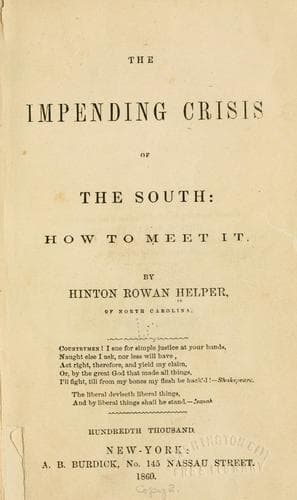
The Impending Crisis of the South: How to Meet ItHelper, Hinton Rowan
History
The Impending Crisis of the South: How to Meet It
Helper, Hinton Rowan
Slavery -- United States
In his present condition, we believe man exercises one of the noblest
virtues with which heaven has endowed him, when, without taking any undue
advantage of his fellow-men, and with a firm, unwavering purpose to
confine his expenditures to the legitimate pursuits and pleasures of life,
he covets money and strives to accumulate it. Entertaining this view, and
having no disposition to make an improper use of money, we are free to
confess that we have a greater penchant for twenty-eight dollars than for
five; for ninety than for fifteen; for a thousand than for one hundred.
South of Mason and Dixon's line we, the non-slaveholders, have 331,902,720
acres of land, the present average market value of which, as previously
stated, is only $5,34 per acre; by abolishing slavery we expect to enhance
the value to an average of at least $28,07 per acre, and thus realize an
average net increase of wealth of more than _seventy-five hundred millions
of dollars_. The hope of realizing smaller sums has frequently induced men
to perpetrate acts of injustice; we can see no reason why the certainty of
becoming immensely rich in real estate, or other property, should make us
falter in the performance of a _sacred duty_.
As illustrative of our theme, a bit of personal history may not be out of
place in this connection. Only a few months have elapsed since we sold to
an elder brother an interest we held in an old homestead which was willed
to us many years ago by our dear departed father. The tract of land,
containing two hundred acres, or thereabouts, is situated two and a half
miles west of Mocksville, the capital of Davie county, North Carolina, and
is very nearly equally divided by Bear Creek, a small tributary of the
South Yadkin. More than one-third of this tract--on which we have plowed,
and hoed, and harrowed, many a long summer without ever suffering from the
effects of _coup de soleil_--is under cultivation; the remaining portion
is a well-timbered forest, in which, without being very particular, we
counted, while hunting through it not long since, sixty-three different
kinds of indigenous trees--to say nothing of either coppice, shrubs or
plants--among which the hickory, oak, ash, beech, birch, and black walnut,
were most abundant. No turpentine or rosin is produced in our part of the
State; but there are, on the place of which we speak, several species of
the genus Pinus, by the light of whose flammable knots, as radiated on the
contents of some half-dozen old books, which, by hook or by crook, had
found their way into the neighborhood, we have been enabled to turn the
long winter evenings to our advantage, and have thus _partially_ escaped
from the prison-grounds of those loathsome dungeons of illiteracy in which
it has been the constant policy of the oligarchy to keep the masses, the
non-slaveholding whites and the negroes, forever confined. The fertility
of the soil may be inferred from the quality and variety of its natural
Public-domain text, read in full here on John Shaqi.
Reviews
Reviews
No reviews yet
Be the first to share your thoughts on this work.
Elsewhere in the archive
Join the Discussion
Join the discussion
Sign in to leave a comment or review.
Sign InorCreate an account