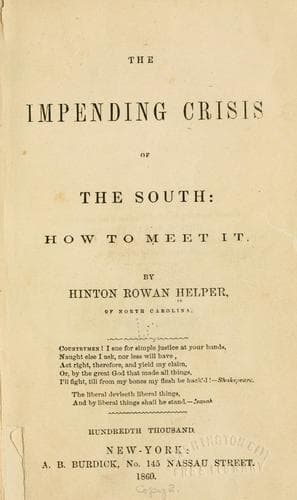
The Impending Crisis of the South: How to Meet ItHelper, Hinton Rowan
History
The Impending Crisis of the South: How to Meet It
Helper, Hinton Rowan
Slavery -- United States
We contend, moreover, that slaveholders are more criminal than common
murderers. We know all slaveholders would not wilfully imbue their hands
in the blood of their fellow-men; but it is a fact, nevertheless, that all
slaveholders are under the shield of a perpetual license to murder. This
license they have issued to themselves. According to their own infamous
statutes, if the slave raises his hand to ward off an unmerited blow, they
are permitted to take his life with impunity. We are personally acquainted
with three ruffians who have become actual murderers under circumstances
of this nature. One of them killed two negroes on one occasion; the other
two have murdered but one each. Neither of them has ever been subjected to
even the preliminaries of a trial; not one of them has ever been arrested;
their own private explanations of the homicides exculpated them from all
manner of blame in the premises. They had done nothing wrong in the eyes
of the community. The negroes made an effort to shield themselves from the
tortures of a merciless flagellation, and were shot dead on the spot.
Their murderers still live, and are treated as honorable members of
society! No matter how many slaves or free negroes may witness the
perpetration of these atrocious homicides, not one of them is ever allowed
to lift up his voice in behalf of his murdered brother. In the South,
negroes, whether bond or free, are never, under any circumstances,
permitted to utter a syllable under oath, except for or against persons of
their own color; their testimony against white persons is of no more
consequence than the idle zephyr of the summer.
We shall now introduce four tables of valuable and interesting statistics,
to which philosophic and discriminating readers will doubtless have
frequent occasions to refer. Tables 22 and 23 will show the area of the
several States, in square miles and in acres, and the number of
inhabitants to the square mile in each State; also the grand total, or the
average, of every statistical column; tables 24 and 25 will exhibit the
total number of inhabitants residing in each State, according to the
census of 1850, the number of whites, the number of free colored, and the
number of slaves. The recapitulations of these tables will be followed by
a complete list of the number of slaveholders in the United States,
showing the exact number in each Southern State, and in the District of
Columbia. Most warmly do we commend all these statistics to the _studious_
attention of the reader. Their language is more eloquent than any possible
combination of Roman vowels and consonants. We have spared no pains in
arranging them so as to express at a single glance the great truths of
which they are composed; and we doubt not that the plan we have adopted
will meet with general approbation. Numerically considered, it will be
perceived that the slaveholders are, in reality, a very insignificant
class. Of them, however, we shall have more to say here after.
Public-domain text, read in full here on John Shaqi.
Reviews
Reviews
No reviews yet
Be the first to share your thoughts on this work.
Elsewhere in the archive
Join the Discussion
Join the discussion
Sign in to leave a comment or review.
Sign InorCreate an account