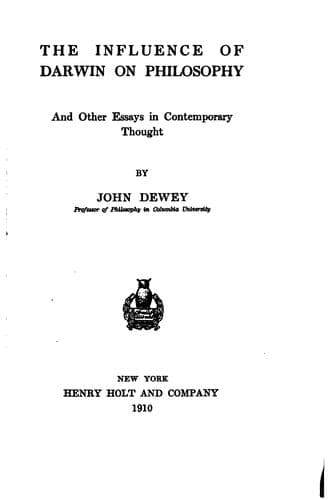
The Influence of Darwin on Philosophy, and other essays in contemporary thoughtDewey, John
Philosophy
The Influence of Darwin on Philosophy, and other essays in contemporary thought
Dewey, John
Evolution; Philosophy; Pragmatism
Explanation, even of an “empirical sort” is as impossible as
determination of a “state” and its classification, when we
rigidly confine ourselves to modifications of consciousness as
a self-existent. Sensations are always defined, classified, and
explained by reference to conditions which, according to the theory,
are extraneous--sense-organs and stimuli. The whole physiological
side assumes a ludicrously anomalous aspect on this basis.[59] While
experimentation is retained, and even made much of, it is at the cost
of logical coherence. To experiment with reference to a bare state
of consciousness is a performance of which one cannot imagine the
nature, to say nothing of doing it; while to experiment with reference
to acts and the conditions of their occurrence is a natural and
straightforward undertaking. Such simple processes as association are
concretely inexplicable when we assume states of consciousness as
existences by themselves. As recent psychology testifies, we again have
to resort to conditions that have no place nor calling on the basis
of the theory--the principle of habit, of neural action, or else some
connection in the object.[60]
We have only to note that there are two opposing schools in psychology
to see in what an unscientific status is the subject. We have only
to consider that these two schools are the result of assuming states
of consciousness as existences _per se_ to locate the source of
the scientific scandal. No matter what the topic, whether memory
or association or attention or effort, the same dualisms present
themselves, the same necessity of choosing between two schools. One,
lost in the distinctions that it has developed, denies the function
because it can find objectively presented only states of consciousness.
So it abrogates the function, regarding it as a mere aggregate of
such states, or as a purely external and factitious relation between
them. The other school, recognizing that this procedure explains away
rather than explains, the values of experience, attempts to even up
by declaring that certain functions are themselves immediately given
data of consciousness, existing side by side with the “states,” but
indefinitely transcending them in worth, and apprehended by some higher
organ. So against the elementary contents and external associations of
the analytic school in psychology, we have the complicated machinery
of the intellectualist school, with its pure self-consciousness as a
source of ultimate truths, its hierarchy of intuitions, its ready-made
faculties. To be sure, these “spiritual faculties” are now largely
reduced to some one comprehensive form--Apperception, or Will, or
Attention, or whatever the fashionable term may be. But the principle
remains the same; the assumption of a function as a given existent,
distinguishable in itself and acting upon other existences--as if
the functions digestion and vision were regarded as separate from
Public-domain text, read in full here on John Shaqi.
Reviews
Reviews
No reviews yet
Be the first to share your thoughts on this work.
Elsewhere in the archive
Join the Discussion
Join the discussion
Sign in to leave a comment or review.
Sign InorCreate an account