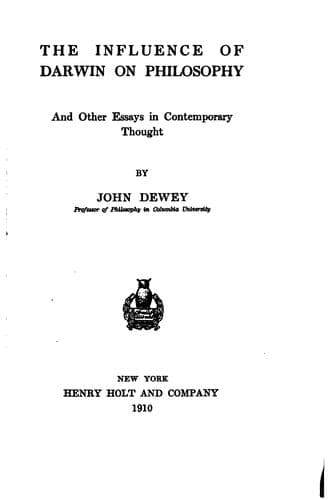
The Influence of Darwin on Philosophy, and other essays in contemporary thoughtDewey, John
Philosophy
The Influence of Darwin on Philosophy, and other essays in contemporary thought
Dewey, John
Evolution; Philosophy; Pragmatism
Students of philosophy will recognize what I mean when I say that this
growing conviction of futility and consequent distaste are associated
with the outcome of the famous dictum of Kant, that perception without
conception is blind, while conception without perception is empty. The
whole course of reflection since Kant’s time has tended to justify this
remark. The sensationalist and the rationalist have worked themselves
out. Pretty much all students are convinced that we can reduce
knowledge neither to a set of associated sensations, nor yet to a
purely rational system of relations of thought. Knowledge is judgment,
and judgment requires both a material of sense perception and an
ordering, regulating principle, reason; so much seems certain, but we
do not get any further. Sensation and thought themselves seem to stand
out more rigidly opposed to each other in their own natures than ever.
Why both are necessary, and how two such opposed factors coöperate in
bringing about the unified result of science, becomes more and more of
a mystery. It is the continual running up against this situation which
accounts for the flagging of interest and the desire to direct energy
where it will have more outcome.
This situation creates a condition favorable to taking stock of the
question as it stands; to inquiring what this interest, prolonged
for over three centuries, in the possibility and nature of knowledge,
stands for; what the conviction as to the necessity of the union of
sensation and thought, together with the inability to reach conclusions
regarding the nature of the union, signifies.
I propose then to raise this evening precisely this question: What
is the meaning of the problem of knowledge? What is its meaning, not
simply for reflective philosophy or in terms of epistemology itself,
but what is its meaning in the historical movement of humanity and as
a part of a larger and more comprehensive experience? My thesis is
perhaps sufficiently indicated in the mere taking of this point of
view. It implies that the abstractness of the discussion of knowledge,
its remoteness from everyday experience, is one of form, rather than of
substance. It implies that the problem of knowledge is not a problem
that has its origin, its value, or its destiny within itself. The
problem is one which social life, the organized practice of mankind,
has had to face. The seemingly technical and abstruse discussion of the
philosophers results from the formulation and statement of the question.
Public-domain text, read in full here on John Shaqi.
Reviews
Reviews
No reviews yet
Be the first to share your thoughts on this work.
Elsewhere in the archive
Join the Discussion
Join the discussion
Sign in to leave a comment or review.
Sign InorCreate an account