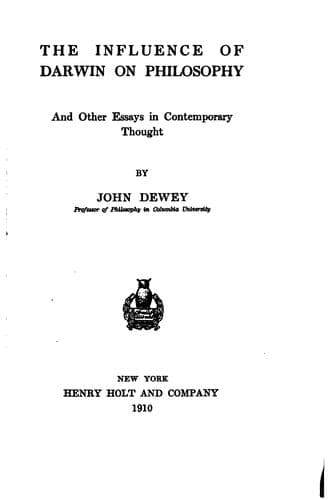
The Influence of Darwin on Philosophy, and other essays in contemporary thoughtDewey, John
Philosophy
The Influence of Darwin on Philosophy, and other essays in contemporary thought
Dewey, John
Evolution; Philosophy; Pragmatism
Social ethics in inclusive sense is the correlative science. Dealing
not with the form or mode or machinery of action, it attempts rather
to make out its filling and make up the values that are necessary to
constitute an experience which is worth while. The sociologist, like
the psychologist, often presents himself as a camp follower of genuine
science and philosophy, picking up scraps here and there and piecing
them together in somewhat of an aimless fashion--fortunate indeed, if
not vague and over-ambitious. Yet social ethics represents the attempt
to translate philosophy from a general and therefore abstract method
into a working and specific method; it is the change from inquiring
into the nature of value in general to inquiring as to the _particular_
values that ought to be realized in the life of every one, and as to
the conditions which render possible this realization.
There are those who will see in this conception of the outcome of a
four-hundred-year discussion concerning the nature and possibility
of knowledge a derogation from the high estate of philosophy. There
are others who will see in it a sign that philosophy, after wandering
aimlessly hither and yon in a wilderness without purpose or outcome,
has finally come to its senses--has given up metaphysical absurdities
and unverifiable speculations, and become a purely positive science
of phenomena. But there are yet others who will see in this movement
the fulfilment of its vocation, the clear consciousness of a function
that it has always striven to perform; and who will welcome it as a
justification of the long centuries when it appeared to sit apart, far
from the common concerns of man, busied with discourse of essence and
cause, absorbed in argument concerning subject and object, reason and
sensation. To such this outcome will appear the inevitable sequel of
the saying of Socrates that “an unexamined life is not one fit to be
led by man”; and a better response to his injunction “Know thyself.”
THE END
INDEX
Absolutism, 18, 25, 98, 102, 109-110, 121-123, 130-132;
_Essay IV._, 142-153, 176, 180-181
Acquaintance, and knowledge, 79-82
Action, and problem of knowledge, _Essay XI._, 271-304
_A priori_, 206-213, 292-294
Appearance, and reality, 26-28, 118-121
Aristotle, referred to, 5, 32, 35, 37, 48, 50, 78, 221, 278
Assurance, 85-88
Awareness, 93
Behavior, and intelligence, 44
Belief, _Essay VI._, 169-197
Bosanquet, B., 281
Bradley, F. H., _Essay IV._, 112-153
Change, its supposed unreality, 1;
in modern science, 8-9;
and law, 72;
and thought, 133;
of truth, 153;
of experience, 222-224, 259-260;
Christianity, metaphysic of, 178
Cognitive, 84-85, 230-233
Conflict, and thinking, 116-117, 126-127, 132, 148-149
Consistency, as criterion, 128-136
Consciousness, as end of nature, 34-35;
is partial, 43;
and knowledge, 79-80, 102, 171;
_Essay X._, 242-270;
non-existence of, 247-248
Public-domain text, read in full here on John Shaqi.
Reviews
Reviews
No reviews yet
Be the first to share your thoughts on this work.
Elsewhere in the archive
Join the Discussion
Join the discussion
Sign in to leave a comment or review.
Sign InorCreate an account