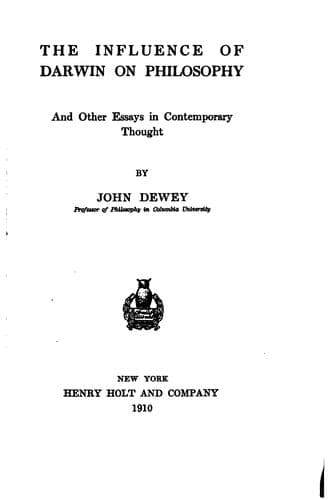
The Influence of Darwin on Philosophy, and other essays in contemporary thoughtDewey, John
Philosophy
The Influence of Darwin on Philosophy, and other essays in contemporary thought
Dewey, John
Evolution; Philosophy; Pragmatism
[48] It would lead us aside from the point to try to tell just what
is the nature of the experienced difference we call truth. Professor
James’s recent articles may well be consulted. The point to bear in
mind here is just what sort of a thing the empiricist must mean by
true, or truer (the noun Truth is, of course, a generic name for all
cases of “Trues”). The adequacy of any particular account is not a
matter to be settled by general reasoning, but by finding out what sort
of an experience the truth-experience actually is.
[49] I say “relatively,” because the transcendentalist still holds
that finally the cognition is imperfect, giving us only some symbol
or phenomenon of Reality (which _is_ only in the Absolute or in some
Thing-in-Itself)--otherwise the curtain-wind fact would have as
much ontological reality as the existence of the Absolute itself: a
conclusion at which the non-empiricist perhorresces, for no reason
obvious to me--save that it would put an end to his transcendentalism.
[50] In general, I think the distinction between -_ive_ and -_ed_ one
of the most fundamental of philosophic distinctions, and one of the
most neglected. The same holds of -_tion_ and -_ing_.
[51] What is criticised, now as “geneticism” (if I may coin the word)
and now as “pragmatism” is, in its truth, just the fact that the
empiricist does take account of the experienced “drift, occasion, and
contexture” of things experienced--to use Hobbes’s phrase.
[52] Perhaps the point would be clearer if expressed in this way:
Except as subsequent estimates of _worth_ are introduced, “real”
means only existent. The eulogistic connotation that makes the term
Reality equivalent to _true_ or _genuine_ being has great pragmatic
significance, but its confusion with reality as existence is the point
aimed at in the above paragraph.
[53] One does not so easily escape medieval Realism as one thinks.
Either every experienced thing has its own determinateness, its own
unsubstitutable, unredeemable reality, or else “generals” _are_
separate existences after all.
[54] Excepting, of course, some negative ones. One could say that
certain views are certainly _not_ true, because, by hypothesis,
they refer to nonentities, _i.e._, non-empiricals. But even here
the empiricist must go slowly. From his own standpoint, even the
most professedly transcendental statements are, after all, real as
experiences, and hence negotiate some transaction with facts. For
this reason, he cannot, in theory, reject them _in toto_, but has to
show concretely how they arose and how they are to be corrected. In a
word, his logical relationship to statements that profess to relate to
things-in-themselves, unknowables, inexperienced substances, etc., is
precisely that of the psychologist to the Zöllner lines.
Public-domain text, read in full here on John Shaqi.
Reviews
Reviews
No reviews yet
Be the first to share your thoughts on this work.
Elsewhere in the archive
Join the Discussion
Join the discussion
Sign in to leave a comment or review.
Sign InorCreate an account