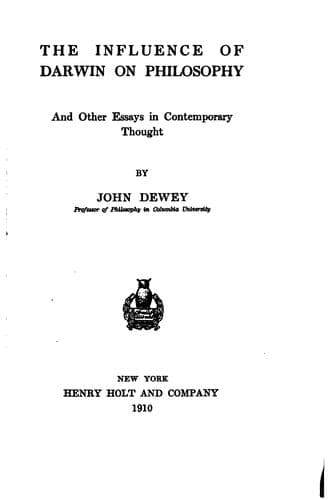
The Influence of Darwin on Philosophy, and other essays in contemporary thoughtDewey, John
Philosophy
The Influence of Darwin on Philosophy, and other essays in contemporary thought
Dewey, John
Evolution; Philosophy; Pragmatism
[60] It may avoid misunderstanding if I anticipate here a subsequent
remark: that my point is not in the least that “states of
consciousness” require some “synthetic unity” or faculty of substantial
mind to effect their association. Quite the contrary; for this theory
also admits the “states of consciousness” as existences in themselves
also. My contention is that the “state of consciousness” as such is
always a methodological product, developed in the course and for the
purposes of psychological analysis.
[61] The “functions” are in truth ordinary everyday acts and attitudes:
seeing, smelling, talking, listening, remembering, hoping, loving,
fearing.
[62] This is perhaps a suitable moment to allude to the absence, in
this discussion, of reference to what is sometimes termed rational
psychology--the assumption of a separate, substantialized ego, soul,
or whatever, existing side by side with particular experiences and
“states of consciousness,” acting upon them and acted upon by them. In
ignoring this and confining myself to the “states of consciousness”
theory and the “natural history” theory, I may appear not only to have
unduly narrowed the concerns at issue, but to have weakened my own
point, as this doctrine seems to offer a special vantage ground whence
to defend the close relationship of psychology and philosophy. The
“narrowing,” if such it be, will have to pass--from limits of time and
other matters. But the other point I cannot concede. The independently
existing soul restricts and degrades individuality, making of it a
separate thing outside of the full flow of things, alien to things
experienced and consequently in either mechanical or miraculous
relations to them. It is vitiated by just the quality already objected
to--that psychology has a separate piece of reality apportioned to
it, instead of occupying itself with the manifestation and operation
of any and all existences in reference to concrete action. From this
point of view, the “states of consciousness” attitude is a much more
hopeful and fruitful one. It ignores certain considerations, to be
sure; and when it turns its ignoring into denial, it leaves us with
curious hieroglyphics. But after all, there is a key; these symbols
can be read; they may be translated into terms of the course of
experience. When thus translated, selfhood, individuality, is neither
wiped out nor set up as a miraculous and foreign entity; it is seen as
the unity of reference and function involved in all things when fully
experienced--the pivot about which they turn.
[63] Delivered before the Philosophical Club of the University of
Michigan, in the winter of 1897, and reprinted with slight change from
a monograph in the “University of Chicago Contributions to Philosophy,”
1897.
Transcriber’s Notes
Punctuation, hyphenation, and spelling were made consistent when a
predominant preference was found in this book; otherwise they were not
changed.
Public-domain text, read in full here on John Shaqi.
Reviews
Reviews
No reviews yet
Be the first to share your thoughts on this work.
Elsewhere in the archive
Join the Discussion
Join the discussion
Sign in to leave a comment or review.
Sign InorCreate an account