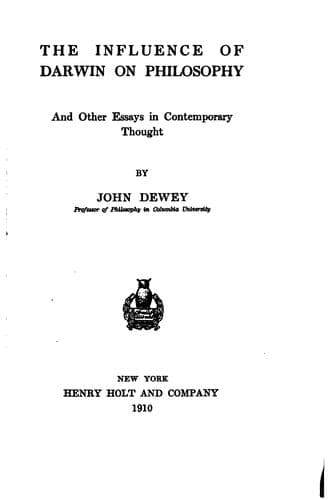
The Influence of Darwin on Philosophy, and other essays in contemporary thoughtDewey, John
Philosophy
The Influence of Darwin on Philosophy, and other essays in contemporary thought
Dewey, John
Evolution; Philosophy; Pragmatism
Here, however, we may be halted. If there is anything present in
“consciousness” at all, we may be told (at least we constantly are so
told) there must be knowledge of it as present--present, at all events,
in “consciousness.” There is, so it is argued, knowledge at least
of a simple apprehensive type, knowledge of the acquaintance order,
knowledge _that_, even though not knowledge _what_. The smell, it is
admitted, does not know _about_ anything else, nor is anything known
_about_ the smell (the same thing, perhaps); but the smell is known,
either by itself, or by the mind, or by some subject, some unwinking,
unremitting eye. No, we must reply; there is no apprehension without
some (however slight) context; no acquaintance which is not either
recognition or expectation. Acquaintance is presence honored with an
escort; presence is introduced as familiar, or an associate springs up
to greet it. Acquaintance always implies a little friendliness; a trace
of re-knowing, of anticipatory welcome or dread of the trait to follow.
This claim cannot be dismissed as trivial. If valid, it carries with
it the distance between being and knowing: and the recognition of
an element of mediation, that is, of art, in all knowledge. This
disparity, this transcendence, is not something which holds of _our_
knowledge, of finite knowledge, just marking the gap between our
type of consciousness and some other with which we may contrast it
after the manner of the agnostic or the transcendentalist (who hold
so much property in joint ownership!), but exists because knowing is
knowing, that way of bringing things to bear upon things which we call
reflection--a manipulation of things experienced in the light one of
another.
Public-domain text, read in full here on John Shaqi.
Reviews
Reviews
No reviews yet
Be the first to share your thoughts on this work.
Join the Discussion
Join the discussion
Sign in to leave a comment or review.
Sign InorCreate an account