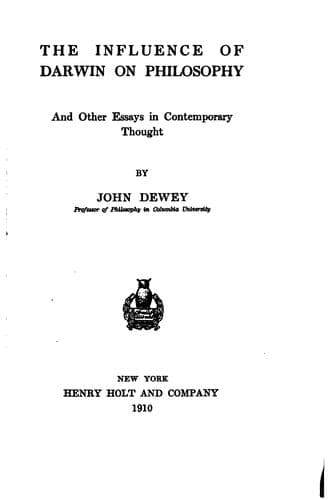
The Influence of Darwin on Philosophy, and other essays in contemporary thoughtDewey, John
Philosophy
The Influence of Darwin on Philosophy, and other essays in contemporary thought
Dewey, John
Evolution; Philosophy; Pragmatism
It should be possible to discern and describe a knowing as one
identifies any object, concern, or event. It must have its own marks;
it must offer characteristic features--as much so as a thunder-storm,
the constitution of a State, or a leopard. In the search for this
affair, we are first of all desirous for something which is for itself,
contemporaneously with its occurrence, a cognition, not something
called knowledge by another and from without--whether this other be
logician, psychologist, or epistemologist. The “knowledge” may turn
out false, and hence no knowledge; but this is an after-affair; it may
prove to be rich in fruitage of wisdom, but if this outcome be only
wisdom after the event, it does not concern us. What we want is just
something which takes itself as knowledge, rightly or wrongly.
I
This means a specific case, a sample. Yet instances are proverbially
dangerous--so naïvely and graciously may they beg the questions at
issue. Our recourse is to an example so simple, so much on its face
as to be as innocent as may be of assumptions. This case we shall
gradually complicate, mindful at each step to state just what new
elements are introduced. Let us suppose a smell, just a floating
odor. This odor may be anchored by supposing that it moves to action;
it starts changes that end in picking and enjoying a rose. This
description is intended to apply to the course of events witnessed and
recounted from without. What sort of a course must it be to constitute
a knowledge, or to have somewhere within its career that which
deserves this title? The smell, _imprimis_, is there; the movements
that it excites are there; the final plucking and gratification are
experienced. But, let us say, the smell is not the smell of the rose;
the resulting change of the organism is not a sense of walking and
reaching; the delicious finale is not the fulfilment of the movement,
and, through that, of the original smell; “is not,” in each case
meaning is “not experienced as” such. We may take, in short, these
experiences in a brutely serial fashion. The smell, _S_, is replaced
(and displaced) by a felt movement, _K_, this is replaced by the
gratification, _G_. Viewed from without, as we are now regarding it,
there is _S-K-G_. But from within, for itself, it is now _S_, now
_K_, now _G_, and so on to the end of the chapter. Nowhere is there
looking before and after; memory and anticipation are not born. Such an
experience neither is, in whole or in part, a knowledge, nor does it
exercise a cognitive function.
Public-domain text, read in full here on John Shaqi.
Reviews
Reviews
No reviews yet
Be the first to share your thoughts on this work.
Join the Discussion
Join the discussion
Sign in to leave a comment or review.
Sign InorCreate an account