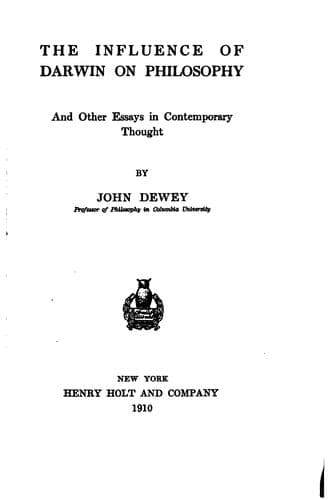
The Influence of Darwin on Philosophy, and other essays in contemporary thoughtDewey, John
Philosophy
The Influence of Darwin on Philosophy, and other essays in contemporary thought
Dewey, John
Evolution; Philosophy; Pragmatism
Let us return to our example. Let us suppose that _S_ is not just
displaced by _K_ and then by _G_. Let us suppose it persists; and
persists not as an unchanged _S_ alongside _K_ and _G_, nor yet as
fused with them into a new further quale _J_. For in such events, we
have only the type already considered and rejected. For an observer
the new quale might be more complex, or fuller of meaning, than the
original _S_, _K_, or _G_, but might not be experienced as complex. We
might thus suppose a composite photograph which should suggest nothing
of the complexity of its origin and structure. In this case we should
have simply another picture.
But we may also suppose that the blur of the photograph suggests
the superimposition of pictures and something of their character.
Then we get another, and for our problem, much more fruitful kind of
persistence. We will imagine that the final _G_ assumes this form:
Gratification-terminating-movement-induced-by-smell. The smell is still
present; it has persisted. It is not present in its original form,
but is represented with a quality, an office, that of having excited
activity and thereby terminating its career in a certain quale of
gratification. It is not _S_, but Σ; that is _S_ with an increment of
meaning due to maintenance and fulfilment through a process. _S_ is no
longer just smell, but smell which has excited and thereby secured.
Here we have a cognitive, but not a cognitional thing. In saying that
the smell is finally experienced as _meaning_ gratification (through
intervening handling, seeing, etc.) and meaning it not in a hapless
way, but in a fashion which operates to effect what is meant, we
retrospectively attribute intellectual force and function to the
smell--and this is what is signified by “cognitive.” Yet the smell is
not cognitional, because it did not knowingly intend to mean this; but
is found, after the event, to have meant it. Nor again is the final
experience, the Σ or transformed _S_, a knowledge.
Here again the statement may be challenged. Those who agree with the
denial that bare presence of a quale in “consciousness” constitutes
acquaintance and simple apprehension, may now turn against us, saying
that experience of fulfilment of meaning is just what we mean by
knowledge, and this is just what the Σ of our illustration is. The
point is fundamental. As the smell at first was presence or being, less
than knowing, so the fulfilment is an experience that is more than
knowing. Seeing and handling the flower, enjoying the full meaning of
the smell as the odor of just this beautiful thing, is not knowledge
because it is more than knowledge.
Public-domain text, read in full here on John Shaqi.
Reviews
Reviews
No reviews yet
Be the first to share your thoughts on this work.
Join the Discussion
Join the discussion
Sign in to leave a comment or review.
Sign InorCreate an account