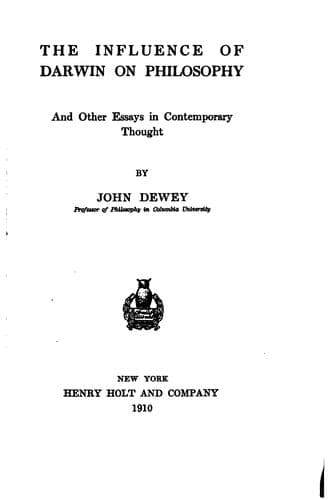
The Influence of Darwin on Philosophy, and other essays in contemporary thoughtDewey, John
Philosophy
The Influence of Darwin on Philosophy, and other essays in contemporary thought
Dewey, John
Evolution; Philosophy; Pragmatism
As this may seem dogmatic, let us suppose that the fulfilment,
the realization, experience, is a knowledge. Then how shall it be
distinguished from and yet classed with other things called knowledge,
viz., reflective, discursive cognitions? Such knowledges are what
they are precisely because they are not fulfilments, but intentions,
aims, schemes, symbols of overt fulfilment. Knowledge, perceptual and
conceptual, of a hunting dog is prerequisite in order that I may really
hunt with the hounds. The hunting in turn may increase my knowledge of
dogs and their ways. But the knowledge of the dog, _qua_ knowledge,
remains characteristically marked off from the use of that knowledge
in the fulfilment experience, the hunt. The hunt is a _realization_ of
knowledge; it alone, if you please, verifies, validates, knowledge, or
supplies tests of truth. The prior knowledge of the dog, was, if you
wish, hypothetical, lacking in assurance or categorical certainty. The
hunting, the fulfilling, realizing experience alone _gives_ knowledge,
because it alone completely assures; makes faith good in works.
Now there is and can be no objection to this definition of knowledge,
_provided it is consistently adhered to_. One has as much right to
identify knowledge with complete assurance, as I have to identify it
with anything else. Considerable justification in the common use of
language, in common sense, may be found for defining knowledge as
complete assurance. But even upon this definition, the fulfilling
experience is not, as such, complete assurance, and hence not a
knowledge. Assurance, cognitive validation, and guaranteeship, follow
from it, but are not coincident with its occurrence. It _gives_,
but _is_ not, assurance. The concrete construction of a story, the
manipulation of a machine, the hunting with the dogs, is not, so far as
it _is_ fulfilment, a confirmation of meanings previously entertained
as cognitional; that is, is not contemporaneously experienced as
such. To think of prior schemes, symbols, meanings, as fulfilled in a
subsequent experience, is reflectively to present in their relations
to one another both the meanings and the experiences in which they
are, as a matter of fact, embodied. This reflective attitude cannot
be identical with the fulfilment experience itself; it occurs only
in retrospect when the worth of the meanings, or cognitive ideas, is
critically inspected in the light of their fulfilment; or it occurs
as an interruption of the fulfilling experience. The hunter stops
his hunting as a fulfilment to reflect that he made a mistake in his
idea of his dog, or again, that his dog is everything he thought he
was--that his notion of him is confirmed. Or, the man stops the actual
construction of his machine and turns back upon his plan in correction
or in admiring estimate of its value. _The fulfilling experience is not
of itself knowledge_, then, even if we identify knowledge with fulness
of assurance or guarantee.
Public-domain text, read in full here on John Shaqi.
Reviews
Reviews
No reviews yet
Be the first to share your thoughts on this work.
Elsewhere in the archive
Join the Discussion
Join the discussion
Sign in to leave a comment or review.
Sign InorCreate an account