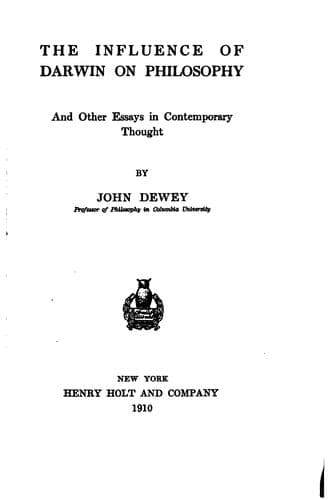
The Influence of Darwin on Philosophy, and other essays in contemporary thoughtDewey, John
Philosophy
The Influence of Darwin on Philosophy, and other essays in contemporary thought
Dewey, John
Evolution; Philosophy; Pragmatism
Moreover it gives, affords, assurance only
in reference to a situation which we have not yet considered.[12]
Before the category of confirmation or refutation can be introduced,
there must be something which _means_ to mean something and which
therefore can be guaranteed or nullified by the issue--and this
is precisely what we have not as yet found. We must return to our
instance and introduce a further complication. Let us suppose that
the smell quale recurs at a later date, and that it recurs neither
as the original _S_ nor yet as the final Σ but as an _S_’ which is
fated or charged with the sense of the possibility of a fulfilment
like unto Σ. The _S_’ that recurs is aware of something else which
it means, which it intends to effect through an operation incited
by it and without which its own presence is abortive, and, so to
say, unjustified, senseless. Now we have an experience which is
_cognitional_, not merely cognitive; which is contemporaneously aware
of meaning something beyond itself, instead of having this meaning
ascribed by another at a later period. _The odor knows the rose; the
rose is known by the odor; and the import of each term is constituted
by the relationship in which it stands to the other._ That is, the
import of the smell is the indicating and demanding relation which it
sustains to the enjoyment of the rose as its fulfilling experience;
while this enjoyment is just the content or definition of what the
smell consciously meant, _i.e._, meant to mean. Both the thing
meaning and the thing meant are elements in the same situation. Both
are present, but both are not present in the same way. In fact, one
is present as-_not_-present-in-the-same-way-in-which-the-other-is.
It is present as something to be rendered present in the same way
through the intervention of an operation. We must not balk at a purely
verbal difficulty. It suggests a verbal inconsistency to speak of
a thing present-as-absent. But all ideal contents, all aims (that
is, things aimed at) are present in just such fashion. Things can
be presented as absent, just as they can be presented as hard or
soft, black or white, six inches or fifty rods away from the body.
The assumption that an ideal content must be either totally absent,
or else present _in just the same fashion_ as it will be when it is
realized, is not only dogmatic, but self-contradictory. The only
way in which an ideal content can be experienced at all is to be
presented as _not-present-in-the-same-way_ in which something else is
present, the latter kind of presence affording the standard or type
of _satisfactory_ presence. When present in the same way it ceases to
be an ideal content. Not a contrast of bare existence over against
non-existence, or of present consciousness over against reality out of
present consciousness, but of a satisfactory with an unsatisfactory
mode of presence makes the difference between the “really” and the
“ideally” present.
Public-domain text, read in full here on John Shaqi.
Reviews
Reviews
No reviews yet
Be the first to share your thoughts on this work.
Elsewhere in the archive
Join the Discussion
Join the discussion
Sign in to leave a comment or review.
Sign InorCreate an account