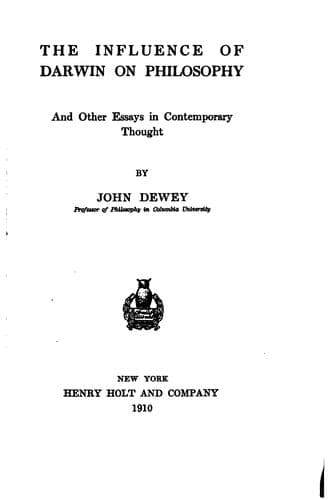
The Influence of Darwin on Philosophy, and other essays in contemporary thoughtDewey, John
Philosophy
The Influence of Darwin on Philosophy, and other essays in contemporary thought
Dewey, John
Evolution; Philosophy; Pragmatism
Such being the case, an examination of Mr. Bradley’s method and
criterion may have far-reaching implications. First, let us set
before ourselves the general points of Mr. Bradley’s indictment of
intellectualism.[20] Knowledge or judgment works by means of thought;
it is predication of idea (meaning) of existence as its subject. Its
final aim is to effect a complete union or harmony of existence and
meaning. But it is fore-doomed to failure, for in realizing its end
it must employ means which contradict its own purpose. This inherent
incapacity lurks in judgment with respect to subject, predicate, and
copula. The predicate or meaning necessary to complete the reality
presented in the subject can be referred to the latter and united with
it only by being itself alienated from existence. It heals the wounds
or deficiencies of its own subject (and in the end all deficiencies are
to the modern idealist discrepancies) only on condition of inflicting
another wound,--only by sundering meaning from a prior union with
existence in some other phase. This latter existence, therefore, is
always left out in the cold. It is as if we wanted to get all the cloth
in the world into one garment and our only way of accomplishing this
were to tear off a portion from one piece of goods in order to patch it
on to another.
The subject of the judgment, moreover, as well as the predicate,
stands in the way of judgment fulfilling its own task. It has
“sensuous infinitude” and it has “immediacy,” but these two traits
contradict each other. The details of the subject always go beyond
itself, being indefinitely related to something beyond. “In its given
content it has relations which do not terminate within that content”
(_ibid._, p. 176), while in its immediacy it presents an undivided
union of existence and meaning. No subject can be mere existence any
more than it can be mere meaning. It is always existent or embodied
meaning. As such it claims individuality or the character of a single
subsistent whole. But this indispensable claim is inconsistent with its
ragged-edged character, its indefinite external reference, which is
indispensable to it as subject that it may require and receive further
meaning from predication.
Public-domain text, read in full here on John Shaqi.
Reviews
Reviews
No reviews yet
Be the first to share your thoughts on this work.
Elsewhere in the archive
Join the Discussion
Join the discussion
Sign in to leave a comment or review.
Sign InorCreate an account