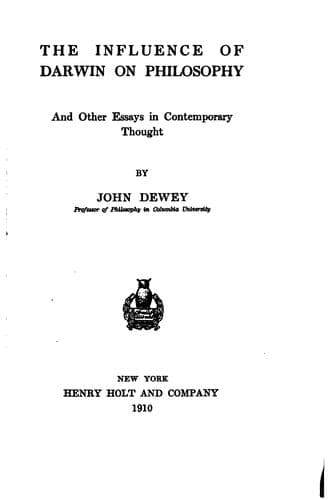
The Influence of Darwin on Philosophy, and other essays in contemporary thoughtDewey, John
Philosophy
The Influence of Darwin on Philosophy, and other essays in contemporary thought
Dewey, John
Evolution; Philosophy; Pragmatism
Speaking of thought he says: “The relational form is a compromise on
which thought stands and which it develops.” And all the particular
antinomies which he discusses are interpreted as having their basis
in the category of relation (_ibid._, p. 180). In his section on
Appearance he goes through various aspects and distinctions of the
world, such as primary and secondary qualities, substance and its
properties, relation and qualitative elements, space and time, motion
and change, causation, etc., pointing out irreconcilable discrepancies
in them. He does not, in a _generalized_ way, expressly refer them
to any common source or root. But it seems a fair inference that the
relational character of thought is at the bottom of the whole trouble:
so that we have in the cases mentioned precisely the same situation
_in concreto_ which is set forth _in abstracto_ in the discussion of
thought. The contradictions brought up are in every case resolved
into the fundamental discrepancy supposed to exist between relations
and elements related. In each case there is the ideal of a final
unity in which relations and elements as such disappear, while in
every case the nature of relation is such as to prevent the desired
consummation. In at least one place, it is expressly declared that it
is the knowledge function which is responsible for the degradation of
reality to appearance. “We do not suggest that the thing always itself
is an appearance. We mean its character is such _that it becomes one as
soon as we judge it_. And this character we have seen throughout our
work, is ideality. Appearance consists in the looseness of content from
existence.... And we have found that everywhere throughout the world
such ideality prevails” (_ibid._, p. 486, italics not in the original).
It is not then strictly true that the divorce of meaning and existence
instigates thought; rather thought is the unruly member that creates
the divorce and then engages in the task (in which it is self-condemned
to failure) of trying to establish the unity which it has gratuitously
destroyed. Thinking, self-consciousness, is disease of the naïve unity
of thoughtless experience.
Public-domain text, read in full here on John Shaqi.
Reviews
Reviews
No reviews yet
Be the first to share your thoughts on this work.
Elsewhere in the archive
Join the Discussion
Join the discussion
Sign in to leave a comment or review.
Sign InorCreate an account