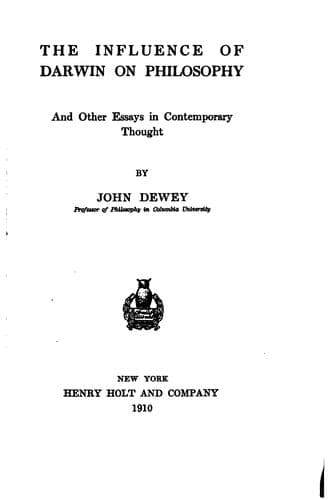
The Influence of Darwin on Philosophy, and other essays in contemporary thoughtDewey, John
Philosophy
The Influence of Darwin on Philosophy, and other essays in contemporary thought
Dewey, John
Evolution; Philosophy; Pragmatism
However that may be, the pragmatist holds that the relation in
question is one of correspondence between existence and thought;
but he holds that correspondence instead of being an ultimate and
unanalyzable mystery, to be defined by iteration, is precisely a
matter of cor-respondence in its plain, familiar sense. A condition of
dubious and conflicting tendencies calls out thinking as a method of
handling it. This condition produces its own appropriate consequences,
bearing its own fruits of weal and woe. The thoughts, the estimates,
intents, and projects it calls out, just because they are attitudes
of response and of attempted adjustment (_not_ mere “states of
consciousness”), produce their effects also. The kind of interlocking,
of interadjustment that then occurs between these two sorts of
consequences constitutes the correspondence that makes truth, just as
failure to respond to each other, to work together, constitutes mistake
and error--mishandling and wandering. This account may, of course, be
wrong--may involve a maladjustment of consequences--but the error in
the account, if it exists, must be specific and empirical, and cannot
be located by general epistemological accusations.
_Pupil: Objection Four._ Well, even admitting this version of
pragmatism, you cannot deny it still contravenes common sense; for,
according to you, the correspondence that constitutes truth does not
exist till _after_ ideas have worked, while common sense perceives and
knows that it is the antecedent agreement of the ideas with reality
that enables them to work. If you make the truth of the existence of a
Carboniferous age, or the landing of Columbus in 1492, depend upon a
future working of an idea about them, you commit yourself to the most
fantastic of philosophies.
Public-domain text, read in full here on John Shaqi.
Reviews
Reviews
No reviews yet
Be the first to share your thoughts on this work.
Elsewhere in the archive
Join the Discussion
Join the discussion
Sign in to leave a comment or review.
Sign InorCreate an account