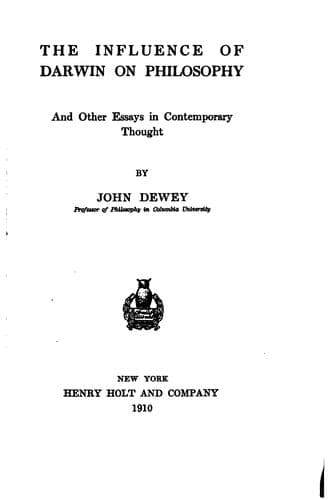
The Influence of Darwin on Philosophy, and other essays in contemporary thoughtDewey, John
Philosophy
The Influence of Darwin on Philosophy, and other essays in contemporary thought
Dewey, John
Evolution; Philosophy; Pragmatism
_Pupil._ What you say calls to mind something of Chesterton’s that I
read recently: “I agree with the pragmatists that apparent objective
truth is not the whole matter; that there is an authoritative need to
believe the things that are necessary to the human mind. But I say
that one of those necessities precisely is a belief in objective truth.
Pragmatism is a matter of human needs and one of the first of human
needs is to be something more than a pragmatist.” You would say, if I
understand you aright, that to fall back upon a supposed necessity of
the “human mind” to believe in certain absolute truths, is to evade a
proper demand for testing the human mind and all its works.
_Teacher._ My son, I am glad to leave the last word with you. This
_enfant terrible_ of intellectualism has revealed that the chief
objection of absolutists to the pragmatic doctrine of the personal (or
“subjective”) factor in belief is that the pragmatist has spilled the
personal milk in the absolutist’s cocoanut.
BELIEFS AND EXISTENCES[26]
I
Beliefs look both ways, towards persons and toward things. They are
the original Mr. Facing-both-ways. They form or judge--justify or
condemn--the agents who entertain them and who insist upon them. They
are of things whose immediate meanings form their content. To believe
is to ascribe value, impute meaning, assign import. The collection and
interaction of these appraisals and assessments is the world of the
common man,--that is, of man as an individual and not as a professional
being or class specimen. Thus things are characters, not mere entities;
they behave and respond and provoke. In the behavior that exemplifies
and tests their character, they help and hinder; disturb and pacify;
resist and comply; are dismal and mirthful, orderly and deformed, queer
and commonplace; they agree and disagree; are better and worse.
Thus the human world, whether or no it have core and axis, has presence
and transfiguration. It means here and now, not in some transcendent
sphere. It moves, of itself, to varied incremental meaning, not to some
far off event, whether divine or diabolic. Such movement constitutes
conduct, for conduct is the working out of the commitments of belief.
That believed better is held to, asserted, affirmed, acted upon. The
moments of its crucial fulfilment are the natural “transcendentals”;
the decisive, the critical, standards of further estimation, selection,
and rejection. That believed worse is fled, resisted, transformed into
an instrument for the better. Characters, in being condensations of
belief, are thus at once the reminders and the prognostications of
weal and woe; they concrete and they regulate the terms of effective
apprehension and appropriation of things. This general regulative
function is what we mean in calling them characters, forms.
Public-domain text, read in full here on John Shaqi.
Reviews
Reviews
No reviews yet
Be the first to share your thoughts on this work.
Elsewhere in the archive
Join the Discussion
Join the discussion
Sign in to leave a comment or review.
Sign InorCreate an account